
The Delaware River in Pennsylvania: Trout, Shad and Smallmouth from the Upper River to Philadelphia
A section-by-section guide to the Delaware River on the Pennsylvania side: wild trout up top, the spring shad run, smallmouth, walleye and stripers, licensing on a border river, and public access.
Related Species
- Brown Trout
- Smallmouth Bass
- Largemouth Bass
- Walleye
- Striped Bass
- Muskellunge
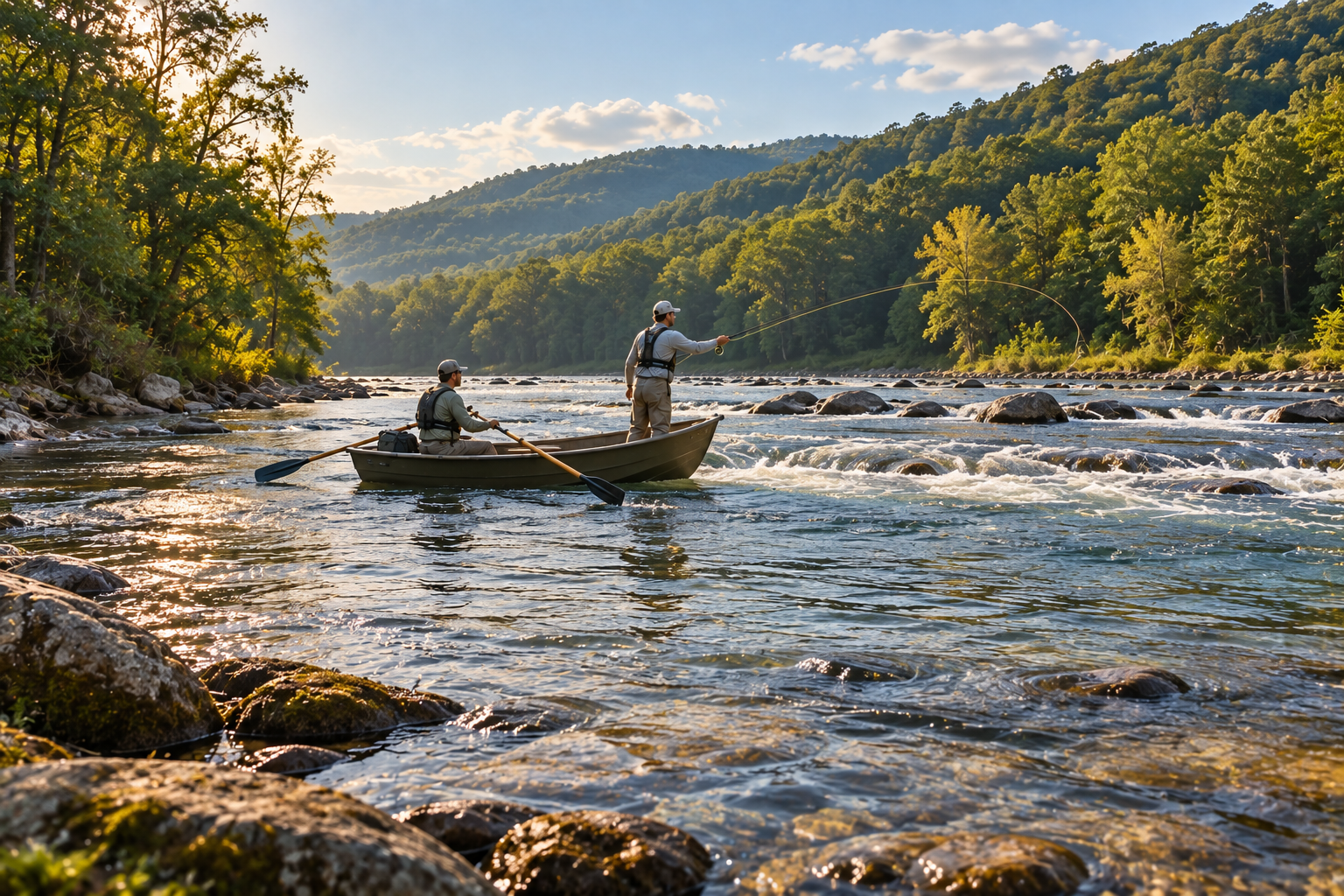
The Delaware River forms Pennsylvania's eastern border with New York and New Jersey, and it changes character as it goes. In its upper reaches it is cold trout water; through the Delaware Water Gap it is a broad, rocky river for smallmouth bass and walleye; and every spring, American shad run up it from the Atlantic. Two national park units protect long stretches of it, and the Pennsylvania Fish and Boat Commission (PFBC) maintains a string of public access areas along the Pennsylvania shore.
This guide walks the river from top to bottom on the Pennsylvania side: what each section is known for, when the shad arrive, the licensing rules that change along a border river, and the public access points in our directory. It does not repeat size or creel limits; the Delaware is a boundary water with its own section of the regulations, so check PFBC's current rules before you keep fish.
The Upper Delaware: trout, shad and smallmouth
Along the New York border, the river is the Upper Delaware Scenic and Recreational River, a unit of the National Park Service managed to keep its scenic and biological character while the surrounding land stays in private ownership. NPS describes the river's water as ideal habitat for a great variety of fish, and its fishing guide breaks the main species down section by section:
- Trout. The colder upper sections are best for rainbow trout and brown trout, and NPS notes that the stretch above Callicoon is known for the best wild trout fishing in the region. The best trout fishing is in late spring and early summer, and it is good again in the fall. Rainbows spawn in the spring, while browns and brook trout spawn in the fall.
- American shad. Shad come up the Delaware from the Atlantic to spawn in spring. NPS says the run starts in the lower river in April and reaches the upper river by early to mid May, with early May the prime time below Callicoon and mid-to-late May above it.
- Smallmouth and largemouth bass. Both are found through the Upper Delaware, usually from Callicoon south, with smallmouth more tolerant of cold water and more numerous farther north. NPS singles out Narrowsburg to Barryville as excellent smallmouth habitat, with plenty of eddies, riffles and rocky bottom.
- Walleye. Usually found in deeper holes and eddies, with the best fishing in spring and fall, at night.
- Striped bass. Like shad, they come up from salt water to spawn; NPS says most are found south of Narrowsburg, holding in deeper pools by day, with the best fishing in spring and fall at night.
- Musky and American eel. Musky ambush prey from shallow, weedy cover, and eels are best fished at night.
Access points in our directory along the Pennsylvania side of the upper river include Balls Eddy, Shehawken, Buckingham Access and Equinunk Access near Starrucca, and Damascus Access, Callicoon, Narrowsburg and Zane Grey near Masthope. NPS notes that not every public access has a boat ramp, but all are usable for smaller non-motorized boats and wading.
Licenses and rules on the Upper Delaware
Above the Delaware Water Gap, the river is the border between Pennsylvania and New York. NPS says a valid New York or Pennsylvania fishing license is required for all anglers 16 and older on that stretch, whether fishing from a boat or either shore, and that New Jersey licenses are not valid there. Pennsylvania license holders also need a trout permit to keep trout. The park's fishing page lists further rules for the river, including limits on the number of lines and restrictions on bait, so read it before you go.
The Delaware Water Gap
Farther downstream, the river flows through Delaware Water Gap National Recreation Area and the Middle Delaware National Scenic and Recreational River, where it forms the border between Pennsylvania and New Jersey. Pennsylvania access points in our directory through this stretch include Matamoras Access, Milford Beach, Dingmans Ferry, Bushkill and Smithfield Beach, along with the Portland Footbridge Access.
The park's rules are worth knowing:
- Licenses. On the Delaware River between Pennsylvania and New Jersey, NPS says anglers can fish from shoreline to shoreline with a license from either state. Streams, ponds and lakes inside the park follow the license rules of the state they are in, and children under 16 do not need a license.
- Life jackets. The river can look calm, but NPS warns that underwater obstacles are a danger. Children 12 and younger must wear a life jacket on any vessel, and everyone in a vessel under 16 feet must wear one from November 1 to April 30.
The lower river: Easton to Trenton
Below the Water Gap, the river runs past Easton toward Trenton. Access points in our directory along this stretch include Martins Creek Access Area, Sandts Eddy, Easton Launch - Scott Park, Upper Black Eddy, Virginia Forrest Recreation Area and Yardley Access.
PFBC tracks this part of the river closely. Its biologist reports for the lower Delaware include smallmouth bass surveys and an assessment of the river's smallmouth population, along with studies of the spring American shad spawning run.
The tidal Delaware
Through Philadelphia and down to the Delaware Estuary, the river is tidal and a different fishery again. PFBC's biologist reports include a run of striped bass surveys in the Delaware Estuary. Tidal access points in our directory include Morrisville, the Neshaminy State Park - Marina ramp near Bristol, the Tacony Boat Launch and Frankford Arsenal in Philadelphia, and the Marcus Hook Access pier.
Shad: handle them with care
American shad are the Delaware's signature spring fish, and PFBC asks anglers to treat them gently because shad are fragile. Its guidance is practical: reel shad in quickly rather than fighting them to exhaustion, land them with a net, keep them in the net and in the water while you remove the hook with pliers, and slide them back into the water from the net rather than dropping or throwing them.
The rules for shad's relatives are strict. PFBC lists hickory shad and river herring as closed year-round in the Delaware River and Estuary, which means no kill: any that are caught must be released immediately and unharmed. American shad have their own Delaware River and Estuary regulation, so check PFBC's current shad rules before keeping one.
Planning a trip
- Match the section to the season. Trout in the cold upper river in late spring and early summer; shad from April in the lower river to mid-to-late May above Callicoon; smallmouth through the summer from Narrowsburg down; walleye and stripers at night in spring and fall.
- Know whose water you're on. A New York or Pennsylvania license covers the river above the Water Gap; Pennsylvania or New Jersey licenses work shoreline to shoreline through the Water Gap and below.
- Wear a life jacket. The river's underwater hazards are easy to miss, and the park requires life jackets for children and, in the colder months, for everyone in small boats.
- Read the current regulations. The Delaware is a boundary water with its own section of the rules in PFBC's summary book.
- Clean, drain, dry. NPS asks anglers to clean plants and mud off boats, waders and gear, drain all water and dry equipment before moving between waters, to keep aquatic invasive species out of the river.
From wild trout in the cold upper river to shad, smallmouth and stripers below, the Delaware rewards anglers who follow it through the seasons.
Related Locations
- Fishing spots in Pennsylvania
- Fishing spots in Starrucca, Pennsylvania
- Fishing spots in Masthope, Pennsylvania
- Fishing spots in Matamoras, Pennsylvania
- Fishing spots in Milford, Pennsylvania
- Fishing spots in Easton, Pennsylvania
- Fishing spots in Yardley, Pennsylvania
- Fishing spots in Philadelphia, Pennsylvania
About the Author
Find Fishing Spots
The Find Fishing Spots editorial team covers all things fishing, from fishing spots and tournaments to species guides, fishing tips, and helpful resources. Find Fishing Spots helps anglers discover new places to fish and useful information for planning their next day on the water.
Sources & Further Reading
- Fishing Regulations — Upper Delaware Scenic & Recreational River (National Park Service) ↗
- Fishing — Upper Delaware Scenic & Recreational River (National Park Service) ↗
- Fishing — Delaware Water Gap National Recreation Area (National Park Service) ↗
- Shad (Pennsylvania Fish and Boat Commission) ↗
- Fishing Information (Delaware River Basin Commission) ↗