
Key Largo Reef Fishing: Wrecks, Mooring Buoys and the Sanctuary Zones
How to fish the reef off Key Largo: which zones allow fishing, the mooring buoys and wrecks in our directory, what the reef holds, and the rules to check before you go.
Related Species
- Yellowtail Snapper
- Red Grouper
- Tarpon
- Lionfish
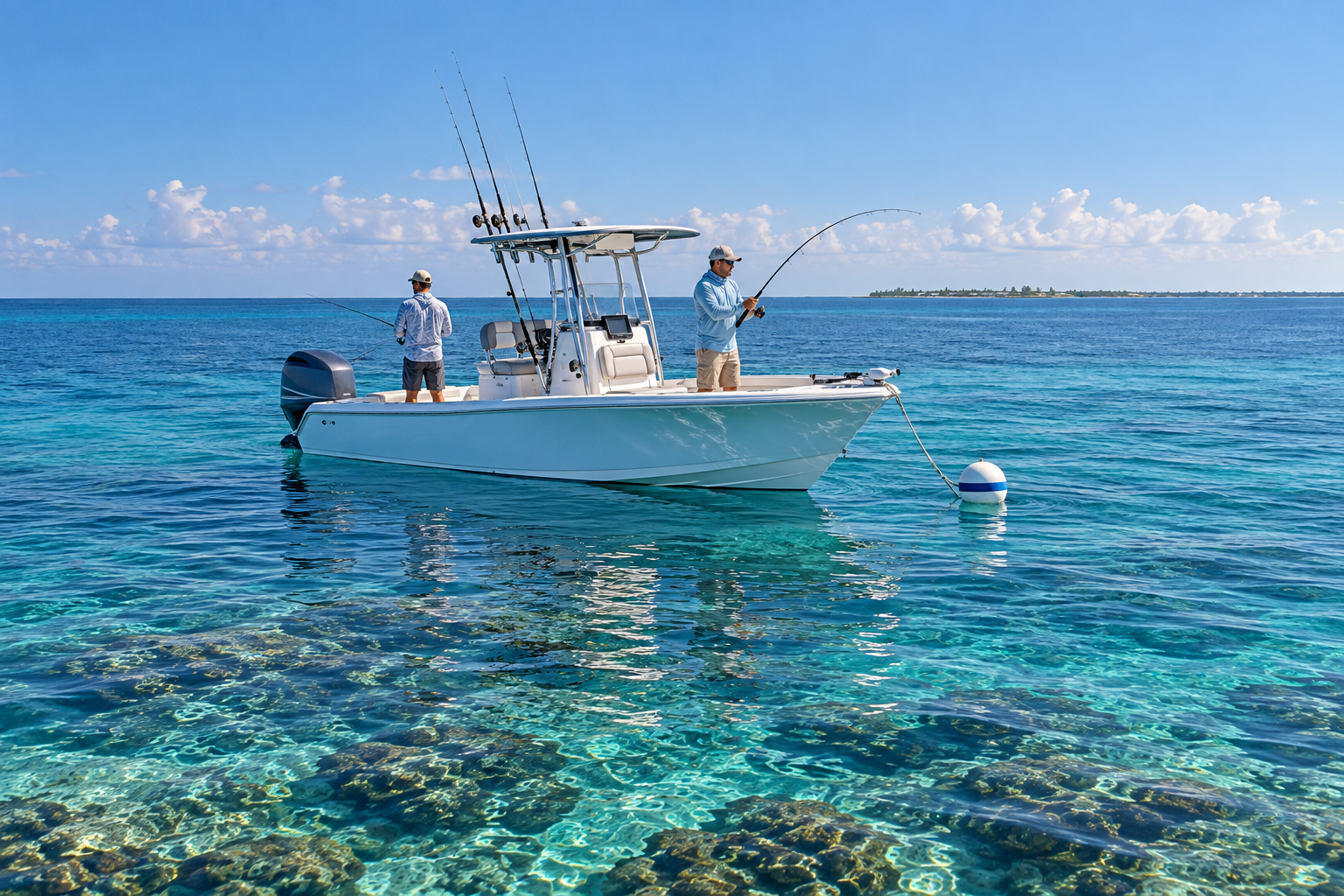
Key Largo sits at the top of the Florida Keys, and NOAA notes that the reefs off its Atlantic shore have served as an example of marine protected areas for decades. That protection shapes how you fish them. Some reefs here are open to hook-and-line fishing, some are closed to fishing entirely, and spearfishing is prohibited throughout the Key Largo Management Area. Knowing which is which matters more at Key Largo than almost anywhere else in Florida.
This guide explains how the water off Key Largo is zoned, where the mooring buoys and wrecks in our directory sit, what the reef holds and how to plan a trip that stays on the right side of the rules. It does not list bag and size limits: they change, and the Florida Fish and Wildlife Conservation Commission (FWC) publishes the current ones.
The reef off Key Largo
Within Florida Keys National Marine Sanctuary lies North America's only coral barrier reef. NOAA describes Florida's Coral Reef as extending over 350 miles, from the Dry Tortugas to the St. Lucie Inlet in Martin County. The outer reef tends to grow in a "spur and groove" pattern of coral ridges separated by sandy channels, and small patch reefs are scattered between the islands and the outer reef.
The sanctuary says the waters off Key Largo are known for stands of elkhorn coral and large mounds of star and brain corals. Those reefs have been protected for a long time: Florida dedicated the Atlantic waters off Key Largo as John Pennekamp Coral Reef State Park in 1960, covering nearshore waters out to the seaward edge of the bank reefs, and the federal Key Largo National Marine Sanctuary followed in 1975. When the Florida Keys sanctuary was expanded and new regulations took effect in 1997, that area became the Key Largo Management Area.
For an angler, the result is a celebrated reef that comes layered with zones. The sanctuary's own fishing page sums up the range of water in the Keys: flats and mangroves in the backcountry, coral reefs, and deep water in the Gulf Stream.
How the zones work
Three layers of rules apply off Key Largo, on top of state and federal fishing regulations.
Sanctuary-wide rules
Throughout Florida Keys National Marine Sanctuary, you may fish unless an activity is specifically prohibited, but some rules apply everywhere:
- Anchoring on living coral is prohibited, as is running a boat in a way that strikes coral or seagrass or causes prop scarring.
- Harvesting marine life must follow FWC rules.
- Feeding or attracting fish, including sharks, from a boat or while diving is prohibited.
- Slow to idle speed and no wake within 300 feet of a "divers down" flag.
The sanctuary points anglers to FWC for state fishing regulations and to the federal fishery councils and NOAA Fisheries for federal ones. It notes that most waters inside the sanctuary overlap state waters, where a Florida fishing license is required.
The Key Largo Management Area
The waters of the former Key Largo National Marine Sanctuary now form the Key Largo Management Area. Hook-and-line fishing is allowed here, but the sanctuary lists several prohibitions specific to this zone:
- No spearfishing. Spearfishing equipment may only be carried while passing through without stopping.
- No tropical fish. Taking any tropical fish is prohibited.
- No coral or invertebrates. Taking or damaging coral, marine invertebrates, plants or rock is prohibited, with the exception that recreational lobster harvest by hand or hand gear is allowed under state and federal rules.
- No bottom gear. Wire fish traps, bottom trawls, dredges, fish sleds and similar towed or anchored bottom gear and nets are prohibited.
Sanctuary Preservation Areas
Sanctuary Preservation Areas (SPAs) are the strictest zones you will meet off Key Largo. According to the sanctuary, they protect shallow reefs along the reef tract, and inside them fishing by any means is prohibited, as is removing or possessing any marine life. Diving, snorkeling and boating are allowed, and mooring buoys are provided so boats don't anchor on coral.
The sanctuary's SPA list includes the Carysfort, The Elbow, Key Largo Dry Rock-Grecian Rocks and Molasses Reef SPAs, all names Key Largo boaters will recognise. Some of those reef names also appear in our directory as listings for the surrounding management area, so always check the zone before you drop a line.
How to tell where you are:
- SPAs are marked by 30-inch yellow buoys around their perimeter.
- Mooring buoys inside an SPA carry a sticker showing that fishing is not allowed.
- The sanctuary's free Marine Sanctuary Explorer app shows the zones with GPS precision, and NOAA suggests the Fish Rules app for state and federal fishing rules.
Anchoring rules in SPAs are also tightening: the sanctuary says that in 2027, anchoring of any kind will be prohibited in SPAs except at a short list of sites, and the Key Largo SPAs named above are not among the exceptions.
Fishing the mooring buoys
Mooring buoys are the main way to fish the Key Largo reef without anchoring on coral. The sanctuary describes them as 18 inches in diameter with a blue stripe, in use in the Keys since 1981, free to use on a first-come, first-served basis and intended for short-term use rather than overnight. There are nearly 500 of them across the sanctuary.
The sanctuary's mooring buoy map lists buoys at reefs outside the SPAs, and several appear in our directory for the Key Largo area:
- Carysfort Trench mooring buoy
- Horseshoe Reef mooring buoy
- North Dry Rocks mooring buoy and North North Dry Rocks mooring buoy
- North East Patch mooring buoy
- Sand Island mooring buoy
- Three Sisters mooring buoy
- Wolfe Reef mooring buoy
- Pickles Reef mooring buoy
- Snapper Ledge mooring buoy
Being outside an SPA doesn't mean anything goes: where a buoy sits inside the Key Largo Management Area, the management area rules still apply, including no spearfishing and no tropical fish. Check each buoy's zone in the Marine Sanctuary Explorer app before you fish it, because zone boundaries can sit close together.
The wrecks
Several of Key Largo's best-known structures are ships. NOAA's mooring buoy map lists Benwood, Bibb, Duane and Spiegel Grove among the sanctuary's artificial reefs, and our directory includes a buoy listing for each.
- Duane — The former U.S. Coast Guard cutter Duane was sunk as an artificial reef in 1987 and, according to the sanctuary, lies upright on a sandy bottom in 120 feet of water about one mile south of Molasses Reef. Its sister ship Bibb rests nearby; the sanctuary describes both as underwater museums and artificial reefs off Molasses Reef.
- Benwood — A freighter that sank after a collision in 1942, Benwood lies between French Reef and Dixie Shoals in depths of 25 to 45 feet, surrounded by low-profile coral reef and sand. NOAA calls it one of the most popular shipwreck dives in the sanctuary.
- Spiegel Grove — The retired USS Spiegel Grove was sunk off Key Largo in June 2002 as an artificial reef, and NOAA set up a monitoring program to study the effects of its sinking.
Wrecks attract divers as well as anglers, so expect dive boats on the buoys, watch for divers-down flags and give them room. The management area's no-spearfishing rule applies on these wrecks too.
What lives on the reef
The sanctuary protects more than 6,000 species of marine life. A few that matter most to anglers:
- Yellowtail snapper. NOAA describes yellowtail as an abundant species most often caught on hook and line in 30 to 120 feet of water on and around reefs and other structure, and as one of many snapper species in the sanctuary.
- Grouper. Several grouper species are native to the sanctuary. NOAA notes that red grouper live inshore for four to five years before moving to offshore hard bottom as adults, and describes groupers as an important sign of a healthy reef.
- Tarpon. On the flats, NOAA calls tarpon a game fish "of the highest order" and says they are found in abundance in the Keys.
- Spiny lobster. Caribbean spiny lobster are taken by recreational divers and commercial fishermen. The sanctuary lists two seasons in Monroe County: a two-day sport season on the last consecutive Wednesday and Thursday of July, and the regular season from August 6 through March 31. Remember that lobstering is allowed in the management area only by hand or hand gear and is never allowed inside an SPA.
- Lionfish. NOAA calls the invasive Indo-Pacific lionfish a serious threat to coral reefs. Because spearfishing is prohibited in the Key Largo Management Area, check the current FWC and sanctuary rules on lionfish removal before trying it here.
The Florida Bay side
Key Largo also faces Florida Bay, a different world of shallow water, mangrove islands and backcountry flats. In our directory, Sunset Point Park Public Boat Ramp provides public boat access to Florida Bay near Key Largo, and the Aerojet Canal Public Access Ramp is a public ramp on the Aerojet Canal near North Key Largo.
Parts of Florida Bay lie within Everglades National Park, which has its own rules and permits. The sanctuary notes that only a few Florida Bay islands in the park can be visited during the day, and that pets are not allowed on islands managed by the National Park Service or the U.S. Fish and Wildlife Service. Check the park's current regulations before fishing the bay side.
John Pennekamp Coral Reef State Park
FWC describes John Pennekamp Coral Reef State Park as the first undersea park in the U.S., covering approximately 70 nautical square miles. Fishing is permitted in designated areas of the park, alongside glass-bottom boat tours, snorkeling, diving, canoeing and kayaking. Because the park overlaps the reef tract and the sanctuary's zones, check the park's own rules as well as the sanctuary's before fishing inside its boundaries.
Planning a trip
- Check the zone first. Load the Marine Sanctuary Explorer app or the sanctuary's interactive maps before you leave the dock. Fishing inside an SPA can bring a federal fine; the sanctuary's own fishing page shows yellowtail snapper caught inside a no-fishing area that led to exactly that.
- Leave spear gear at home. Off Key Largo, spearfishing is prohibited throughout the management area.
- Use the buoys. Tie up to a mooring buoy rather than anchoring, and never anchor on coral.
- Read the current rules. Get bag limits, size limits and seasons from FWC, and the sanctuary's regulations summary (opens in a new tab) for zone rules.
- Consider a Blue Star guide. The sanctuary recognises Blue Star Fishing Guides who follow its best practices, an option worth considering for a first trip to the reef.
Key Largo rewards anglers who treat the rules as part of the fishing: the right buoy, the right zone and the right gear turn a crowded reef into one of the best-protected fisheries in Florida.
Related Locations
Related Fishing Tournaments
2027 Florida Keys Lionfish Derby
Apr 22–Apr 25, 2027 · Key Largo, Florida
Gold Cup Tarpon Tournament 2027
Jun 21–Jun 25, 2027 · Islamorada, Florida
Don Hawley Invitational Tarpon Fly Tournament
No upcoming event announced
Last held Jun 5, 2026 · Islamorada, Florida
About the Author
Find Fishing Spots
The Find Fishing Spots editorial team covers all things fishing, from fishing spots and tournaments to species guides, fishing tips, and helpful resources. Find Fishing Spots helps anglers discover new places to fish and useful information for planning their next day on the water.