
Lake Cumberland: Striped Bass, Smallmouth and the Trout Tailwater Below Wolf Creek Dam
How to fish Lake Cumberland and the Cumberland River tailwater: stripers, smallmouth, walleye and crappie on the lake, trout below Wolf Creek Dam, and the public access in between.
Related Species
- Striped Bass
- Smallmouth Bass
- Largemouth Bass
- Spotted Bass
- Walleye
- Black Crappie
- White Crappie
- Rainbow Trout
- Brown Trout
- Cutthroat Trout
- Sauger
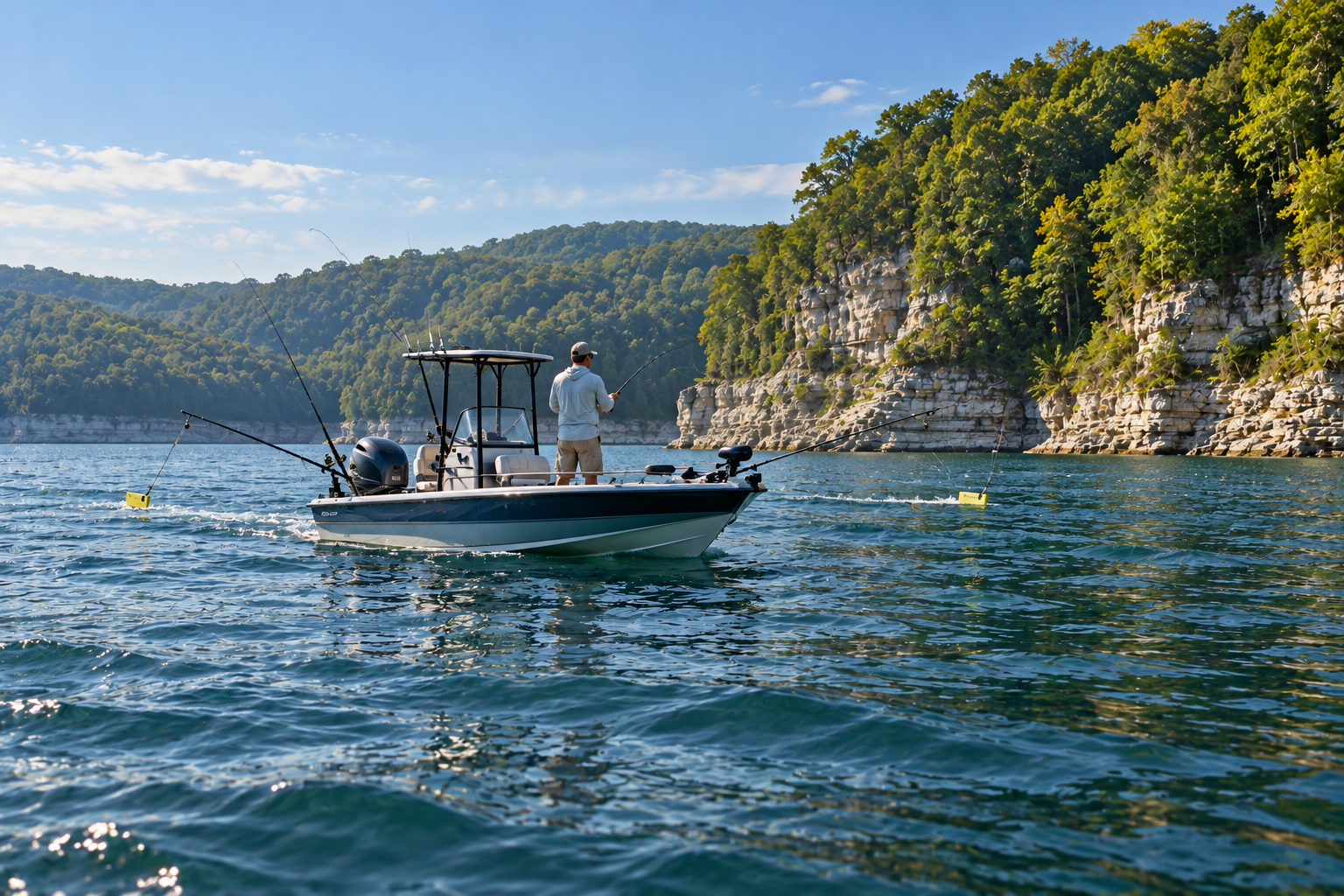
Lake Cumberland is two fisheries in one. Above Wolf Creek Dam lies a large reservoir in southern Kentucky that the Kentucky Department of Fish and Wildlife Resources (KDFWR) says is well known for its smallmouth bass, largemouth bass, striped bass and walleye. Below the dam, the cold Cumberland River tailwater is, in KDFWR's words, the best trout fishing water in Kentucky. A trip can mean trolling for a trophy striper at dawn or wading a gravel shoal for rainbow and brown trout before the dam starts generating.
This guide covers both: how the lake and the tailwater fish, the public ramps and access points in our directory, and the things that matter most for planning, from creek arms and fish attractors to dam release schedules. Size limits here are special to Lake Cumberland, so the guide points you to KDFWR's current regulations rather than repeating them.
The lake
KDFWR lists Lake Cumberland at 47,688 acres, in the Wayne, Russell and Pulaski County area of southern Kentucky. Much of the striped bass fishing KDFWR describes revolves around the lake's creek arms and how fish move through them as the water warms.
KDFWR maintains fish attractors in the lake and publishes their locations in Google Maps and ArcGIS from the Lake Cumberland page on its website, which is worth loading onto your phone or graphs before you launch.
Striped bass
Striped bass are one of Lake Cumberland's headline fish. KDFWR stocks it with striped bass every year, and its biologists reported in 2022 that fall sampling had produced the highest catch rate of stripers over 25 inches ever recorded on the lake, with very good growth across all sizes. The department also announced that it would stock 500,000 striped bass every year from then on, up from its previous rotation.
KDFWR's spring fishing coverage describes how local anglers pursue them in late winter and early spring: trolling live shad and alewives under planer boards, and starting at the back of a creek arm before working toward the middle. In mid-March, stripers typically hold in water around 48 to 51 degrees, and as the water warms the pattern moves shallower. Free-lining live bait with no weight is another approach anglers use. Once you find fish, the advice is simple: repeat the same depth, weight and method until you find more.
Kentucky Fish and Wildlife's Trophy Fish Award program recognizes striped bass of 36 inches or longer. Lake Cumberland has its own minimum size and daily limit for striped bass, so check the current lake regulations before keeping one.
Smallmouth, largemouth and spotted bass
KDFWR's Fishing Forecast lists Lake Cumberland among the Kentucky lakes that offer a good chance at a smallmouth bass of a lifetime in late winter and early spring. Largemouth bass are also a headline species, and spotted bass are present as well. The lake carries special minimum size limits for largemouth and smallmouth bass.
Walleye
KDFWR's forecast names Lake Cumberland among the lakes with excellent walleye fisheries, and notes that walleye and sauger fishing peaks in late winter in tailwaters below dams, including on the Cumberland. The lake has its own walleye size and daily limit.
Crappie
KDFWR reported a burgeoning population of 12- to 14-inch crappie in Lake Cumberland, powered by strong reproduction in 2019 and 2020. Both black crappie and white crappie are present, and the lake has a special minimum size limit for both.
Lake sturgeon
Lake sturgeon are a protected species on Lake Cumberland and must be released immediately if caught.
Public access around the lake
KDFWR lists dozens of public access sites around Lake Cumberland, from paved ramps at state parks and recreation areas to small unpaved launches up the creek arms. Access points in our directory include:
- Around Burnside and the upper lake: Burnside Island State Park Ramp, Lee's Ford Dock, Waitsboro Recreation Area and Cumberland Point Recreation Area.
- Around Monticello and the south side: Fall Creek Recreation Area and Harmon Creek Ramp.
- Around Jamestown and the lower lake: Lily Creek Ramp, Halcomb's Landing and Alligator I.
- Near Albany: Fryman's Landing.
Ramp surfaces, fees and the size of boat each ramp suits vary; KDFWR's access list notes which ramps are paved, which charge a fee and which are better suited to lighter boats. Check the details for each site before towing a large boat to an unfamiliar ramp.
The Cumberland River tailwater
Wolf Creek Dam holds back Lake Cumberland, and the cold water released from its turbines creates what KDFWR calls one of the premier trout fishing destinations in the southeastern United States. The Kentucky portion of the tailwater runs about 75 miles, and it has produced the state record 21-pound brown trout and a 14-pound, 6-ounce rainbow trout.
Rainbow and brown trout are the mainstays, and KDFWR's coverage also mentions brook trout and stocked cutthroat trout. The river holds walleye, sauger and oversized striped bass too.
Dam releases come first
KDFWR is blunt about safety below the dam: Wolf Creek Dam unleashes a powerful current that can be dangerous, and releases of more than two turbines mean high, swift water that makes fishing the upper river nearly impossible. Water can rise quickly, and wading anglers need to leave the river as soon as it starts to come up.
Before any tailwater trip, check the generation schedule. KDFWR points anglers to the U.S. Army Corps of Engineers Nashville District and the Tennessee Valley Authority release schedules for Wolf Creek, where 45 indicates one turbine running. In summer, power demand usually peaks in the afternoon and evening, so mornings are often the best window for wading near the dam.
Float and wade access
KDFWR's tailwater guide describes the river below the dam section by section, and many of the access points it names are in our directory:
- Kendall Ramp, at the Kendall Recreation Area below the dam, is a common launch for a short float.
- Little Indian Creek Access, at the end of Ray Mann Road, reaches Boyd's Bar, a productive wading shoal for rainbow and brown trout. KDFWR notes that the water rises quickly here when the dam generates.
- Helms Landing, a little over 4.5 miles downstream of the dam, is a popular wading spot; KDFWR says the deeper channel across from the ramp holds trout and large browns gather in the eddy below it when there is current.
- Rockhouse (Creelsboro Arch) is reached by walking through a massive natural bridge. KDFWR suggests fishing downstream toward the Gateway Rocks, and warns that the carry through the arch makes it a poor take-out for johnboats.
- Long Bar Fishing Access, on the island shoal just above the Rockhouse Hole, is one of the better wading shoals in this section.
- Winfreys Ferry marks the end of the first 16 miles below the dam, which KDFWR describes as great water for canoes, kayaks and small johnboats.
Farther downstream near Burkesville, KDFWR's fall and winter coverage highlights the Bakerton and Crocus Creek area, which is less affected by releases than the upper river. Access points there include Bakerton (Fish Tales) Ramp, Crocus Creek Fishing Access, Rainbow Run and the Burkesville Ramp.
What works on the tailwater
KDFWR's suggestions are a useful starting point. For spinning anglers: red, white or chartreuse in-line spinners and small suspending jerkbaits, with corn, salmon eggs and redworms as traditional baits. For fly anglers: beadhead pheasant tail nymphs and small midges for rainbows, and larger woolly buggers, shad-colored streamers and crayfish patterns near woody cover for browns.
Because the dam controls water temperature, the tailwater fishes consistently through the year. KDFWR's biologists describe fall and winter as the best time for big trout, when large fish move into the shallows to feed, while summer wading offers a way to escape the heat on cold water.
Planning a trip
- Pick the lake or the river by season and target. Late winter and spring for big stripers and smallmouth on the lake; mornings in summer and the cooler months for trout below the dam.
- Load the fish attractor maps from KDFWR's Lake Cumberland page before fishing the lake.
- Check the Wolf Creek generation schedule before every tailwater trip, and get out of the river as soon as the water starts rising.
- Read the special regulations. Lake Cumberland has its own size and daily limits for crappie, black bass, striped bass and walleye, and lake sturgeon must be released. Check KDFWR's Lake Cumberland page (opens in a new tab) for the current rules.
- Use KDFWR's access tools. The "Find a Place to Fish" section of the KDFWR website and the Fish Boat KY app list access sites with directions.
Lake Cumberland rewards anglers who pay attention to the details: the right creek arm and water temperature for stripers, and the right release window and wading shoal for trout below the dam.
Related Locations
About the Author
Find Fishing Spots
The Find Fishing Spots editorial team covers all things fishing, from fishing spots and tournaments to species guides, fishing tips, and helpful resources. Find Fishing Spots helps anglers discover new places to fish and useful information for planning their next day on the water.
Sources & Further Reading
- Lake Cumberland — Waterbody Detail and Special Regulations (Kentucky Department of Fish and Wildlife Resources) ↗
- Fishing Forecast (Kentucky Department of Fish and Wildlife Resources) ↗
- Spring Fishing Frenzy – Lake Cumberland reporting record numbers of bigger striped bass (Kentucky Department of Fish and Wildlife Resources) ↗
- Cumberland River Tailwater (Kentucky Department of Fish and Wildlife Resources) ↗
- Wade the Lake Cumberland tailwater to beat the heat and catch fish (Kentucky Department of Fish and Wildlife Resources) ↗