
Lake Hartwell: Bass, Stripers and Crappie on the South Carolina–Georgia Line
How to fish Lake Hartwell on the South Carolina–Georgia line: black bass, stocked stripers and hybrids, crappie and walleye, SCDNR's habitat work, and public ramps, piers and bank access.
Related Species
- Largemouth Bass
- Spotted Bass
- Smallmouth Bass
- Striped Bass
- Hybrid Striped Bass
- Black Crappie
- Walleye
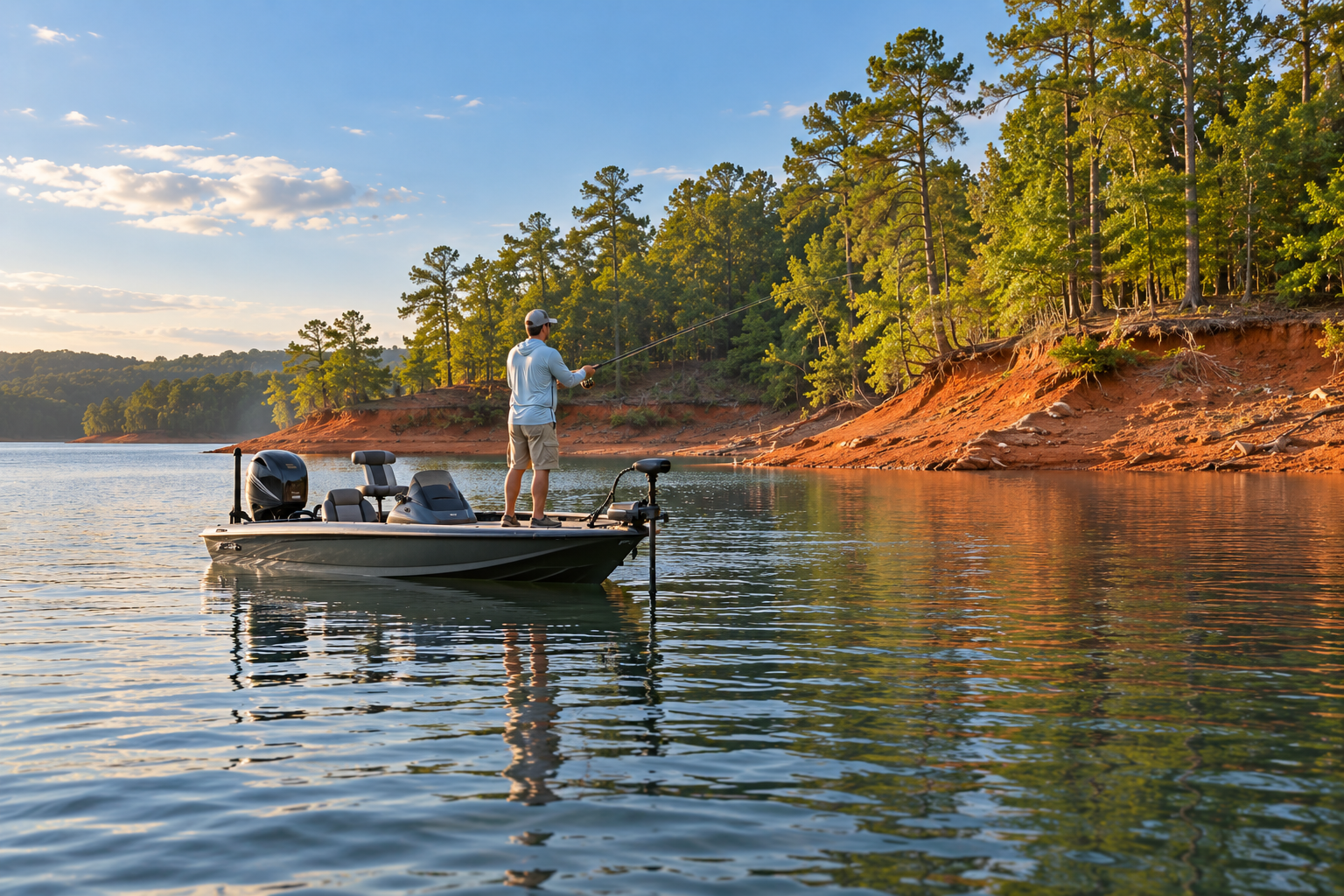
Lake Hartwell sits on the South Carolina–Georgia state line. The South Carolina Department of Natural Resources (SCDNR) describes it as one of the most popular lakes in the Southeast and a fishing hotspot, with outstanding opportunities for three species of black bass, striped and hybrid bass, black crappie and bream. It has hosted the Bassmaster Classic four times.
This guide covers the lake itself, how its main fisheries behave through the year, the habitat and stocking work behind them, and the public ramps, piers and bank access in our directory on both the South Carolina and Georgia shores. It does not repeat creel or size limits; check the current regulations for the state where you fish.
The lake
According to SCDNR, Lake Hartwell was the second U.S. Army Corps of Engineers reservoir built on the Savannah River. It covers 56,000 acres with 962 miles of shoreline, has an average depth of 45 feet and a maximum depth of 185 feet, and is surrounded by more than 23,000 acres of public land. SCDNR's lake profile lists 45 boat ramps, 11 fish attractors, two fishing access locations, a fishing loaner tackle location and five marinas with pumpouts, with the South Carolina side of the lake in Anderson, Oconee and Pickens counties.
Much of the seasonal fishing described below follows fish moving between the river arms, creeks and the deep main lake.
Black bass
Hartwell's reputation was built on bass. SCDNR notes that the 2022 Bassmaster Classic made it the fourth time the event had been held on the lake, after 2008, 2015 and 2018, and that Hartwell has been listed as a Top 100 Bass Lake in America. Georgia's Wildlife Resources Division lists largemouth bass and spotted bass among Hartwell's best bets, and Georgia's Tugaloo State Park also lists smallmouth bass among the lake's fish.
The guide reports that SCDNR and Georgia's Wildlife Resources Division publish describe a clear seasonal rhythm:
- Late winter. In February, the best bet is targeting points, brush or rocks in deep water with drop shots, underspins or football jigs, particularly early in the day.
- Spring. The bass spawn on Hartwell usually extends into May, overlapping with the blueback herring spawn, and the topwater bite comes on as surface temperatures climb into the upper sixties and seventies.
- Late summer and fall. By September, bass usually get on a bait pattern, chasing schools of bait over deep water and shallower humps, with topwaters, flukes and swimbaits all working.
Striped and hybrid bass
Striped bass and hybrid striped bass are Hartwell's other big draw, and they are a product of SCDNR's stocking program. In a single three-week stretch in 2016, the agency stocked about 780,000 striped bass and 480,000 hybrid bass in Lake Hartwell. The striped bass fingerlings are around 1.5 to 2 inches long when stocked and can be expected to reach catchable size in two to three years. SCDNR notes that all of the striped bass stocked in Hartwell are the Savannah River strain, a genetically distinct strain that originated in the Savannah River drainage.
Seasonally, the guide reports describe stripers and hybrids partway up the rivers in winter, holding on the bottom in 35 to 50 feet of water. On warm afternoons late in the winter, when the water reaches the low to mid fifties, fish move up onto wind-blown red clay points and banks to feed. Cold water slows them down: one February report noted water as low as 43 degrees and described stripers as sluggish in the low forties.
Georgia's Wildlife Resources Division has also studied where Hartwell's stripers go as conditions change through the year. Its fisheries biologist explains that telemetry work, and what water quality means for the lake's stripers, in this presentation:
Crappie
Black crappie are one of SCDNR's headline species for Hartwell. The guide reports describe crappie around deeper docks on jigs and minnows in early winter, moving shallower into open water and onto brush as temperatures warm, and stacking up on mid-depth brush after the spawn ends in late April, where they suspend over wood in the middle of the water column.
Walleye
Hartwell also has a walleye run. In March 2025, a Georgia DNR fisheries biologist reported walleye slowly making their way upstream through the Tugaloo River, with DNR sampling picking up more fish each week as the water edged toward 50 °F.
Habitat work: where the fish concentrate
SCDNR began a major habitat enhancement project on Lake Hartwell in 2014. Through 2021, the agency enhanced eight areas with about 105 concrete culverts and structures, 1,300 stumps, 560 tons of broken concrete slabs, 180 tons of riprap, PVC and bamboo fish attractors, 815 trees cut and cabled from the shoreline and 1,200 maidencane plants. SCDNR's stated goals were to provide cover for fish of various sizes and to create fish concentration sites for anglers, so those enhanced areas and the lake's fish attractors are logical places to start.
Public access
Hartwell has a large network of public access on both sides of the state line. Access points in our directory include:
South Carolina shore
- Green Pond near Centerville, with Green Pond Recreation Area Bank for shore anglers.
- Lake Hartwell State Park and Lake Hartwell State Park Bank near Fair Play. South Carolina State Parks lists two boat ramps and a courtesy dock at the park.
- Sadlers Creek State Park and Sadlers Creek State Park Bank near Anderson.
- Fishing piers at Broyles Recreation Area Pier, Twin Lakes Recreation Area Pier, Seneca Creek Pier, Darwin H. Wright Park Pier and the Hwy 123 Fishing Pier.
- Boat ramps including Twelve Mile near Clemson and Singing Pines near Anderson.
Georgia shore
- Tugalo State Park. Georgia State Parks says the most popular bank fishing spots there are along the shoreline behind the office and around the day-use area, and that visitors can borrow a fishing pole from the park office.
- Hart SP Day Use, Big Oaks Recreation Area and Long Point Recreation Area near Reed Creek.
- Stephens County Park near Toccoa.
With this many piers and bank areas, Hartwell is a practical lake for anglers without a boat.
Licenses on a two-state lake
Because Hartwell straddles the state line, check which state's license you need for where you plan to fish. South Carolina State Parks requires a valid South Carolina fishing license at Lake Hartwell State Park, and Georgia State Parks requires anglers 16 or older at Tugaloo State Park to hold a Georgia fishing license and follow Georgia's size and creel rules. Read both states' current regulations before your trip.
Planning a trip
- Pick the season. Deep points and brush for bass in late winter, shallow water and the herring spawn in spring, and bait-chasing fish over deep water and humps from late summer into fall.
- Follow the stripers up and down the rivers. Winter fish hold partway up the river arms; warm afternoons push them onto wind-blown clay points.
- Start at structure. SCDNR's fish attractors and its enhanced habitat areas were built to concentrate fish for anglers.
- Use the reports. SCDNR's Freshwater Fishing Trends and Georgia WRD's weekly fishing report both carry regular Hartwell updates.
Hartwell rewards anglers who match the season: deep structure in winter, the herring spawn in spring, and open-water schools of bait as summer turns to fall.
Related Locations
- Fishing spots in South Carolina
- Fishing spots in Georgia
- Fishing spots in Centerville, South Carolina
- Fishing spots in Fair Play, South Carolina
- Fishing spots in Anderson, South Carolina
- Fishing spots in Clemson, South Carolina
- Fishing spots in Northlake, South Carolina
- Fishing spots in Westminster, South Carolina
- Fishing spots in Gumlog, Georgia
- Fishing spots in Reed Creek, Georgia
- Fishing spots in Toccoa, Georgia
About the Author
Find Fishing Spots
The Find Fishing Spots editorial team covers all things fishing, from fishing spots and tournaments to species guides, fishing tips, and helpful resources. Find Fishing Spots helps anglers discover new places to fish and useful information for planning their next day on the water.
Sources & Further Reading
- Lake Hartwell (South Carolina Department of Natural Resources) ↗
- Freshwater Fishing Trends (South Carolina Department of Natural Resources) ↗
- Fishing Forecasts (Georgia DNR Wildlife Resources Division) ↗
- Bassmaster Classic returns to Lake Hartwell for fourth time — habitat enhancement (South Carolina Department of Natural Resources) ↗
- Lake Hartwell State Park — Things To Do (South Carolina State Parks) ↗
- Fishing — Tugaloo State Park (Georgia State Parks) ↗