
Largemouth Bass in Indiana: Spawning, Habitat, DNR Management and Lake-Specific Limits
An Indiana largemouth guide: DNR growth and spawning data, habitat and depth maps, reservoir habitat work, statewide limits and the waters with special bass rules.
Related Species
- Largemouth Bass
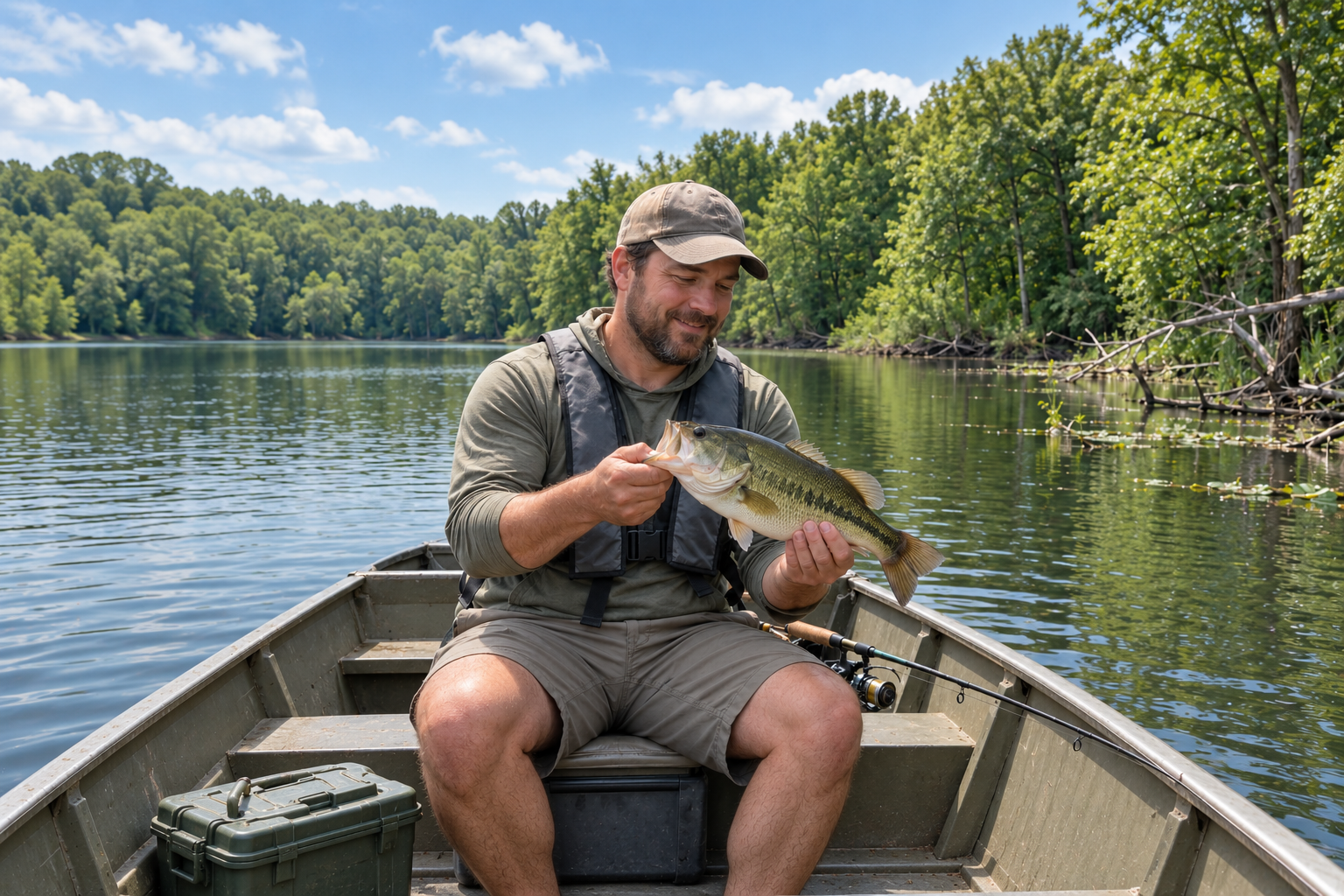
Largemouth bass can be found in nearly all Indiana waterbody types, including ponds, lakes, reservoirs, streams and rivers. Creel surveys cited by the Indiana Department of Natural Resources (opens in a new tab) indicate that largemouth are one of the most popular sport fish among Indiana anglers, and the DNR estimates that approximately one-third of all Indiana anglers target them.
This guide gathers what the DNR publishes about the species in Indiana — growth, spawning, habitat and management — along with the statewide limits and the long list of waters with their own size and bag rules. Find Fishing Spots lists more than 600 Indiana locations tagged for largemouth bass, in more than 190 cities; a listing marks a place to fish, not a rating of the fishery.
Telling a largemouth from other black bass
The DNR describes largemouth as generally olive green overall with a cream-colored belly and a series of black blotches forming a line along the side. The quickest check is the jaw: on a largemouth the upper jaw extends beyond the back of the eye, while on smallmouth and spotted bass it does not. The distinction matters because Indiana's statewide black bass bag limits count largemouth, smallmouth and spotted bass together.
Growth, spawning and the seasons
Indiana largemouth typically grow 3 to 4 inches per year for the first three years, then 1 to 2 inches per year through age 8, and less than 1 inch per year after age 8. Juveniles eat crustaceans, insects and insect larvae, while adults primarily feed on fish, crayfish and large insects.
Spawning begins in spring after the water temperature reaches approximately 65°F. Males build the nests in water anywhere from 1 to 15 feet deep, but nests are typically in water less than 5 feet deep, and gravel is the preferred bottom. The eggs typically hatch in three to four days, depending on water temperature. The fry stay in a tight school until 26 to 31 days after hatching, when they are about one inch long, and the male remains nearby to protect them.
Habitat: where largemouth live
Largemouth prefer warm, moderately clear waters that do not have a noticeable current. The DNR calls aquatic vegetation and woody debris necessary components of high-quality habitat for largemouth.
The littoral zone is the shallow nearshore area where there is enough light for aquatic vegetation to grow. Approximately half of a typical Indiana glacial lake's littoral zone contains submerged aquatic vegetation, while vegetation is less prevalent in reservoirs.
The DNR's reservoir habitat guidance (opens in a new tab) notes that hardwood and cedar piles may help attract black bass, crappies and juvenile sunfish. It also notes that small fish prefer dense cover such as cedar, while large fish tend to congregate around less-dense trees like oaks.
Depth and vegetation maps
The DNR publishes lake depth and vegetation maps (opens in a new tab) for selected Indiana lakes, searchable by name or county, and a lake may have several maps from different years. Mapped waters include Bixler Lake (Noble County), Clear Lake (LaPorte County), Hardy Lake (Scott and Jefferson counties) and Ferdinand State Forest Lake (Dubois County).
How the DNR manages largemouth
DNR fisheries biologists manage largemouth in public waterbodies by evaluating data from fisheries surveys and angler creel surveys. Since 2010, they have completed more than 200 general fish community and targeted largemouth surveys.
Why largemouth are not stocked
The DNR stocks very few naturally reproducing species anywhere in the state, because these fish can sustain their own populations. The agency cites studies from other states finding that stocked largemouth either disappear after two years or outcompete and replace the natural stock, with no change in overall largemouth numbers. Instead, where largemouth populations are low and habitat is limiting, the DNR uses artificial fish structures to supplement natural habitat.
Reservoir habitat work
The Reservoir Habitat Enhancement Program (opens in a new tab), which started in 2016, improves habitat through placement of structures, shoreline stabilization and dredging. The DNR reports more than 10 different habitat-enhancement projects across Indiana since 2016. Waters on its interactive project map include Cecil M. Harden Lake, J.C. Murphey Lake, Lake Sullivan, Mississinewa and Salamonie lakes, Monroe Lake and Patoka Lake.
Structures used include Pennsylvania bass nesting platforms, which provide nesting and nursery habitat for largemouth and shallow-water (less than 10 feet) cover. Habitat waypoints can be downloaded as GPX files to import into a depth finder or GPS unit.
The Tri Lakes relocation
The DNR's Tri Lakes project, which moved its first fish in May 2024, targeted small, slow-growing bass: the agency described most Tri Lakes bass as between 8.0 and 13.5 inches, with growth well below average for the area. Under the plan behind the May 2024 relocation, the DNR intended to remove approximately 1,000 small bass per year for five years and relocate them to nearby J.E. Roush Lake, where largemouth density was low. In May 2024, 955 largemouth bass from 6.2 to 13.9 inches long, averaging 10.2 inches, were relocated from Tri-Lakes to J.E. Roush Lake in Huntington. The DNR planned a second round of relocations, along with a survey, for May 2025; check the DNR's largemouth page for any later update on that round.
Regulations
Indiana's 2026-2027 regulations guide is a summary, and complete rules are in Indiana Code and Indiana Administrative Code Title 312. The regulations apply to fish from Indiana's public waters and do not apply to fish in private waters that did not originate from public waters.
Statewide black bass limits
The statewide black bass regulations (opens in a new tab) set three standards by type of water:
- Lakes: 5 bass a day in any combination of largemouth, smallmouth or spotted bass, 14-inch minimum size.
- Rivers and streams: 5 a day in any combination; no fish 12 to 15 inches may be kept, and no more than two fish over 15 inches may be kept.
- Lake Michigan: 3 a day in any combination, 14-inch minimum size.
The possession limit is two times the daily bag limit, and it does not apply to fish that are processed and stored at an individual's primary residence. Sorting is allowed within the bag: in the DNR's example, if you catch five largemouth and later catch a bigger one, it is legal to release any of the others in good condition to keep the larger fish. Dead and dying fish cannot be released, and released fish must go back into the water they came from and be able to swim away normally.
Waters with special largemouth limits
The DNR says special largemouth regulations are in effect for many Indiana waters, with expected benefits including more bass caught (although many must be released), larger bass and, in some cases, larger bluegill.
- 15-inch minimum: Patoka Lake (Orange, Dubois and Crawford counties).
- 16-inch minimum: Cecil M. Harden Lake (Raccoon SRA, Parke County).
- 18-inch minimum, two-fish daily bag: Ball Lake (Steuben County), Blue Grass Pit and Loon Pit (Warrick County), Fidler Pond (Elkhart County), Failing Lake, also known as Gentian Lake (Steuben County), and Flat Fork Creek Park ponds A and B (Hamilton County).
- Also 18-inch minimum, two-fish daily bag: Kunkel Lake (Wells County), Robinson Lake (Whitley and Kosciusko counties), all lakes at Tri-County Fish & Wildlife Area, Bixler Lake, Henderson, Little Long and Round lakes (Noble County), and J.C. Murphey Lake at Willow Slough Fish & Wildlife Area (Newton County).
- 20-inch minimum, one-fish daily bag: Turtle Creek Reservoir (Sullivan County).
- 12- to 15-inch slot: Buffalo Trace Lake (Harrison County), Ferdinand State Forest Lake (Dubois County) and Montgomery City Park Lake (Daviess County).
- 12- to 15-inch slot with no more than two bass larger than 15 inches: Big Long Lake (LaGrange County).
- No minimum size: Brownstown Pit (Jackson County), Burdette Park lakes (Vanderburgh County), Chandler Town Lake (Warrick County), Cypress Lake (Jackson County), Deming Park lakes (Vigo County), Garvin Park Lake (Vanderburgh County) and Glen Miller Pond (Wayne County).
- Also no minimum size: Hayswood Lake (Harrison County), Henry County Memorial Park Lake (Henry County), Hovey Lake at Hovey Lake Fish & Wildlife Area (Posey County), Krannert Lake, Lake Sullivan and Ruster Lake (Marion County), and Schnebelt Pond (Dearborn County).
At the slot-limit lakes, largemouth from 12 to 15 inches may not be harvested, and the daily bag applies to bass under 12 inches and over 15 inches.
Rivers and streams
Sugar Creek in Montgomery, Parke, Boone, Clinton and Tipton counties has a 20-inch minimum size and a one-fish daily bag. All rivers and streams in Posey, Vanderburgh, Warrick, Spencer, Perry, Crawford, Harrison, Floyd, Clark, Jefferson, Switzerland, Ohio and Dearborn counties have a 12-inch minimum and a 5-bass daily limit, except the Blue River, where the slot limit applies in Crawford, Harrison and Washington counties. The Ohio River is covered by separate Ohio River regulations, so check that section of the guide before fishing it.
Gear, boats and tournaments
The DNR's general fishing regulations (opens in a new tab) cap gear: you may not fish with more than three poles or hand lines at a time, and each line may have no more than three hooks, three artificial lures, or a combination of three. Umbrella rigs (sometimes called Alabama rigs) are allowed, but hooks or lures can be attached to only three arms. Where warning signs are present at a low head dam, you may not fish within 50 feet of it.
On state-owned, leased or managed lakes smaller than 300 acres, only electric trolling motors may be used, with no more than two 12-volt batteries or one 24-volt battery. Fishing tournaments on DNR properties with 15 or more watercraft are required to obtain a fishing tournament permit. The DNR notes that the health of fish and wildlife may be affected if lead or zinc sinkers are ingested, and lists steel, bismuth, tungsten and resin as alternatives.
Border waters
Under Indiana's border-water rules (opens in a new tab), a reciprocal agreement on the Ohio River lets residents of Indiana or Kentucky fish the main stem with either state's license, but a connecting tributary or embayment requires that state's license. On the Wabash River where it forms the Illinois–Indiana boundary, both states accept either state's valid license, but you may not fish in tributaries, bayous or backwaters of the state where you are not licensed. Wolf Lake, shared with Illinois, has no reciprocal license agreement, so each state's license is needed for its own waters.
Planning a trip
The DNR's main fishing page links fish survey reports, lake depth maps and fish stocking information, which are worth checking for a specific lake before a trip. Before keeping a bass, confirm whether the water has a special limit: a 14-inch fish that is legal under the statewide lake rule is too short on an 18-inch or 20-inch lake. Then use our Indiana listings to find public shore, pier and ramp access near the water you choose.
Related Locations
- Fishing spots in Indiana
- Fishing spots in Morocco, Indiana
- Fishing spots in Angola, Indiana
- Fishing spots in Goshen, Indiana
- Fishing spots in Kendallville, Indiana
- Fishing spots in Fishers, Indiana
- Fishing spots in Merom, Indiana
- Fishing spots in Ferdinand, Indiana
- Fishing spots in Evansville, Indiana
- Fishing spots in Mount Vernon, Indiana
- Fishing spots in Hammond, Indiana
- Fishing spots in Huntington, Indiana
- Fishing spots in Smithville-Sanders, Indiana
About the Author
Find Fishing Spots
The Find Fishing Spots editorial team covers all things fishing, from fishing spots and tournaments to species guides, fishing tips, and helpful resources. Find Fishing Spots helps anglers discover new places to fish and useful information for planning their next day on the water.