
Fishing the Suwannee River: Suwannee Bass, Panfish and Catfish
A reach-by-reach guide to fishing the Suwannee River: Suwannee bass, panfish and catfish, public ramps from White Springs to Fowler's Bluff, water levels and jumping sturgeon.
Related Species
- Suwannee Bass
- Largemouth Bass
- Redbreast Sunfish
- Spotted Sunfish
- Bluegill
- Redear Sunfish
- Channel Catfish
- Blue Catfish
- Spotted Seatrout
- Red Drum
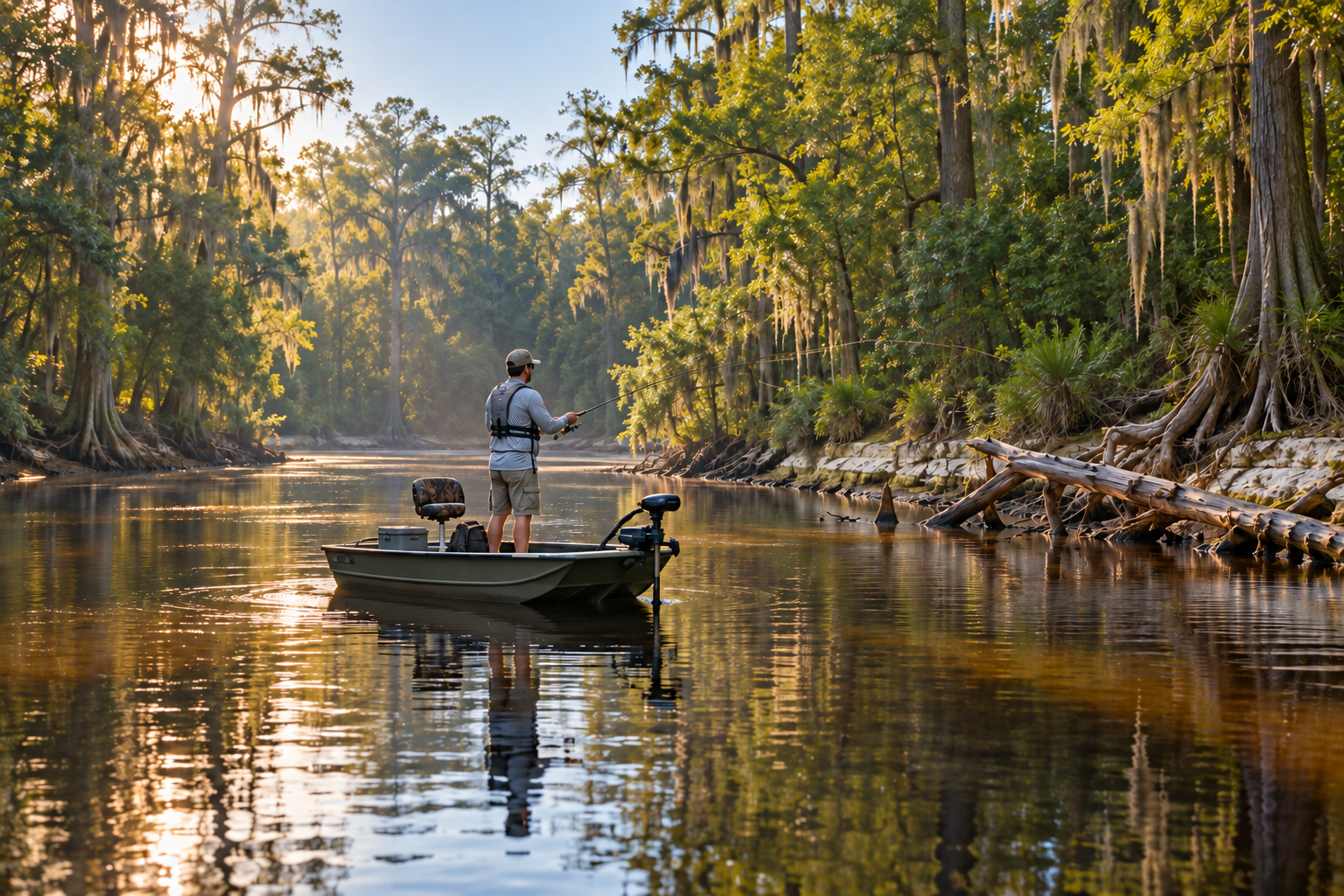
The Suwannee is one of north Florida's signature rivers. It drains from the Okefenokee Swamp, cuts through limestone shoals in its upper reaches, widens into a big floodplain river and finally meets the Gulf through a maze of tidal creeks and marsh. Along the way it passes dozens of small public landings, and it holds a fish found in only a handful of river systems: the Suwannee bass.
The Florida Fish and Wildlife Conservation Commission (FWC) puts it plainly: drastic water level fluctuations characterize the river and keep the fishery dynamic. Water level is the single biggest factor in a Suwannee trip, so this guide works through the river reach by reach, links the public ramps in our directory and covers the safety issues, from low-water hazards to jumping sturgeon, that make this river different.
How the river changes from top to bottom
FWC's description of the river breaks into three parts, and each fishes differently.
- The upper Suwannee runs over limestone shoals. FWC notes that fish structure here is limited to tree roots and rocky shelves, so cover is easy to read but scarce.
- The Santa Fe River is the Suwannee's major tributary. FWC describes it as heavily influenced by springs and, unlike the main river, with large areas of submerged vegetation in its middle and upper reaches.
- The lower Suwannee is a big floodplain river with a band of waterlilies along the banks and, in the tidal portion, numerous wooded and marsh-lined feeder creeks before it reaches the Gulf.
Through all of it, FWC offers a reading of the river that every angler can use: the outer bends are always deeper, sand bars sit on the inside curves, and lilies on an outer bend show where the current has left the bank, which is where panfish like to spawn.
The fish
Suwannee bass and Florida bass
FWC says both Suwannee bass and largemouth (Florida) bass occur in the river, and that large fish are not the rule. Its advice for both is consistent: all bass in the river, especially Suwannees, prefer to feed on crawfish, so crawfish-colored lures prevail.
The Suwannee bass is the river's signature fish. FWC describes it as a heavy-bodied black bass that seldom exceeds 12 inches long, with bright turquoise coloring on the cheeks, breast and belly of mature fish. It is a riverine fish, often found in moderate to swift current near limestone or woody structure, and it spawns from February to June. Outside the Suwannee itself, FWC lists it in the Ichetucknee, Santa Fe, St. Marks, Wacissa and Wakulla rivers, along with the Alapaha, Ochlockonee and Withlacoochee rivers shared with Georgia. The Florida state record is 3.89 pounds.
FWC notes that most Suwannee bass are caught by anglers fishing for other species, on small crayfish-colored spinnerbaits, crankbaits, plastic worms, jigs and crayfish. The agency's current forecast suggests working submerged wood, rocky structure, deeper bends and places where current moves around cover, especially for Suwannee bass, which favor flowing water.
Know the size rule. Under FWC's statewide freshwater rules, no person may kill or possess a Suwannee bass less than 12 inches in total length, and Suwannee bass count toward the black bass daily bag limit. Check the current FWC freshwater regulations (opens in a new tab) before keeping any bass.
Panfish
The Suwannee and especially the Santa Fe are panfish water. FWC credits the Santa Fe's submerged vegetation with harboring abundant freshwater shrimp, scuds and aquatic insects, which produce excellent growth rates for fish, particularly redbreast sunfish and spotted sunfish, the "stumpknockers." FWC lists bluegill, redear sunfish and redbreast sunfish among the river's popular species, and suggests small lures, jigs, crickets and worms fished close to woody cover and along the bank, with slower, subtler presentations in clear water.
Catfish
FWC describes a substantial catfish fishery on the Suwannee River, including blue catfish capable of reaching very large sizes. Channel catfish and blue catfish can be targeted with cut or stink bait fished near the bottom in deeper holes, outside bends, drop-offs, and around submerged logs and undercut banks.
The tidal river
Near the Gulf, the river's fishery broadens. The U.S. Fish and Wildlife Service says Lower Suwannee National Wildlife Refuge offers bank fishing and boat ramps with access to the Suwannee and its tributaries or to the Gulf and its tidal creeks. Freshwater species there include largemouth bass, Suwannee bass, white bass, crappie, sunfish and catfish, while saltwater species include spotted seatrout, flounder, red drum, Spanish mackerel and tarpon. FWC adds that on the lower river, fishing is slow at high tide, with the best fishing during lower tides.
Public access, reach by reach
The Suwannee River is lined with public ramps, from county parks with restrooms to primitive landings. Facilities, parking and hours vary, and some ramps become unusable at low water, so check each listing and current river levels before you go.
Upper river: White Springs and Jasper
The upper river is the shoal-and-limestone stretch. Access points in our directory include the White Springs Public Boat Ramp and Park and two landings on Suwannee River Water Management District (SRWMD) land north of White Springs: the Turner Bridge Tract Boat Ramp and the Roline Tract Boat Launch. The district notes that both tracts are part of the Cypress Creek Wildlife Management Area, where hunting is allowed in permitted areas, so wear something bright during hunting seasons.
Middle river: Dowling Park to Branford
Below the upper shoals, the river runs past a string of landings in our directory, including Dowling Park Public Boat Ramp, Hal Adams Bridge Public Boat Ramp near Mayo, Lafayette Blue Springs State Park Boat Ramp and Ivey Memorial Park and Boat Ramp at Branford.
Lower river: Rock Bluff to Fanning Springs
On the lower river, ramps in our directory include the two Rock Bluff ramps, Rock Bluff Ferry Landing Park on the Gilchrist County side and the Rock Bluff Public Boat Ramp on the Dixie County side, plus Gornto (Guaranto) Springs Park and Boat Ramp and Purvis Landing Park and Boat Ramp near Fanning Springs.
Toward the Gulf: Manatee Springs to Fowler's Bluff
Farther downstream, the SRWMD notes that Usher Landing at Manatee Springs State Park is used to launch boats as well as for parking, picnicking and fishing; it is listed in our directory as Manatee Springs State Park - Usher Landing. Below it are Clay Landing Public Boat Ramp, Camp Azalea Public Boat Ramp, Yellow Jacket Landing Boat Ramp and Fowler's Bluff Public Boat Ramp. Below that lies the tidal river and Lower Suwannee National Wildlife Refuge.
Reading the water level
No other factor matters as much on the Suwannee River. FWC's forecast stresses that boaters should be extremely cautious when the river is low, because low water makes clearance over sand bars, rocks, logs and other hazards less certain, and that river levels can change rapidly after rainfall. The agency recommends checking current conditions before launching, using the SRWMD's real-time river levels or USGS water data.
High water brings its own rules. FWC can activate idle-speed, no-wake zones on the Suwannee and Santa Fe when river gauges pass set levels. On the Suwannee, those zones have included the stretch from Little River Spring to the County Road 340 bridge at Rock Bluff, measured on the Branford gauge, and several segments around New Clay Landing, Camp Azalea, Yellow Jacket Landing and Fowler's Bluff, measured on the Wilcox gauge. Check FWC's announcements before running the river after heavy rain.
Near the mouth, FWC has been replacing and relocating navigation markers in McGriff Pass, Alligator Pass and Salt Creek to better show the most navigable routes. The agency notes that these channels are not dredged, so use the markers and caution in narrow, shallow areas.
Jumping sturgeon
The Suwannee River is one of the rivers where Gulf sturgeon return from the Gulf to spawn, and they jump. FWC describes Gulf sturgeon as large fish that can exceed eight feet in length, and boaters have been injured by direct strikes. There is no warning: if a boat passes as a fish is in the air, people on board can be hurt.
FWC's advice for Suwannee boaters, particularly through the summer:
- Go slow to give the operator more time to react.
- Stay alert and watch and listen for jumping fish.
- Always wear a life jacket, which will keep you afloat if you are knocked out of the boat.
- Keep passengers off the bow in areas where sturgeon are known to jump.
FWC says the fish commonly jump where they gather in "holding" areas, usually the deeper holes in the river. It lists major holding areas above Jack's Sandbar, below Manatee Springs, between Fanning Springs and Usher Landing, below Old Town Trestle, below the confluence of the Santa Fe and Suwannee, near Rock Bluff and below Anderson Springs. Several of those are close to the ramps listed above.
Gulf sturgeon are protected under state and federal law and cannot be harvested. FWC asks boaters to report sturgeon collisions to its Wildlife Alert Hotline.
Planning a trip
- Check the river level first. It decides which ramps are usable, how the fish are positioned and whether a no-wake zone is in effect.
- Pick your reach by target. Rocky upper shoals and current for Suwannee bass, spring-fed water and vegetation for panfish, deep outside bends and holes for catfish, and the tidal river for a mixed freshwater and saltwater catch.
- Plan around the tide on the lower river. FWC's guidance is that lower tides fish best.
- Respect the sturgeon. Slow down, keep the bow clear and wear your life jacket.
- Know the bass rule. Release any Suwannee bass under 12 inches.
The Suwannee rewards anglers who match the river's mood: a low, clear river for slow, careful presentations, a rising river for patience and caution, and always the crawfish-colored lure that FWC says the river's bass prefer.
Related Locations
Related Fishing Tournaments
About the Author
Find Fishing Spots
The Find Fishing Spots editorial team covers all things fishing, from fishing spots and tournaments to species guides, fishing tips, and helpful resources. Find Fishing Spots helps anglers discover new places to fish and useful information for planning their next day on the water.
Sources & Further Reading
- Suwannee and Santa Fe Rivers — Fishing Sites & Forecasts (Florida Fish and Wildlife Conservation Commission) ↗
- Suwannee Bass — Species Profile (Florida Fish and Wildlife Conservation Commission) ↗
- General Statewide Bag and Length Limits — Freshwater (Florida Fish and Wildlife Conservation Commission) ↗
- FWC urges boaters to go slow and be alert for jumping sturgeon (Florida Fish and Wildlife Conservation Commission) ↗
- Fishing at Lower Suwannee National Wildlife Refuge (U.S. Fish and Wildlife Service) ↗