
Tuna Lures: Trolling, Jigging and Topwater
The trolling lures, jigs and topwater plugs that catch tuna, plus how to match them to species and conditions and rig them to hold up.
Related Species
- Yellowfin Tuna
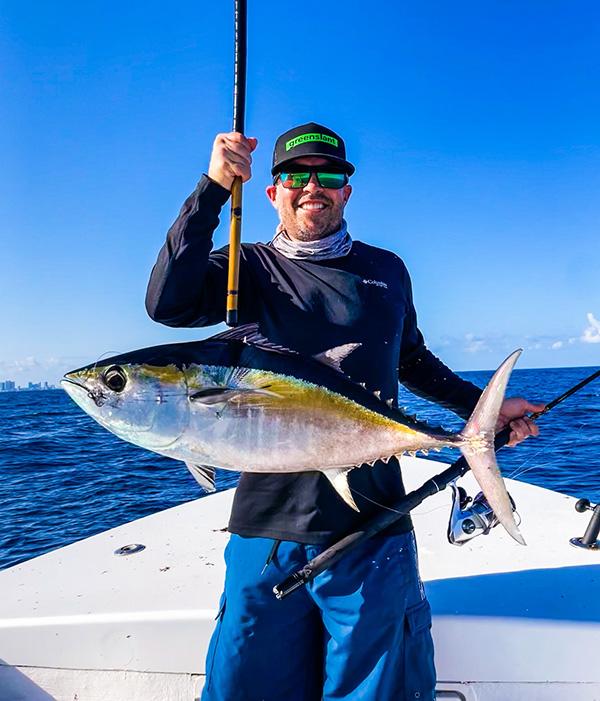
- Blackfin Tuna
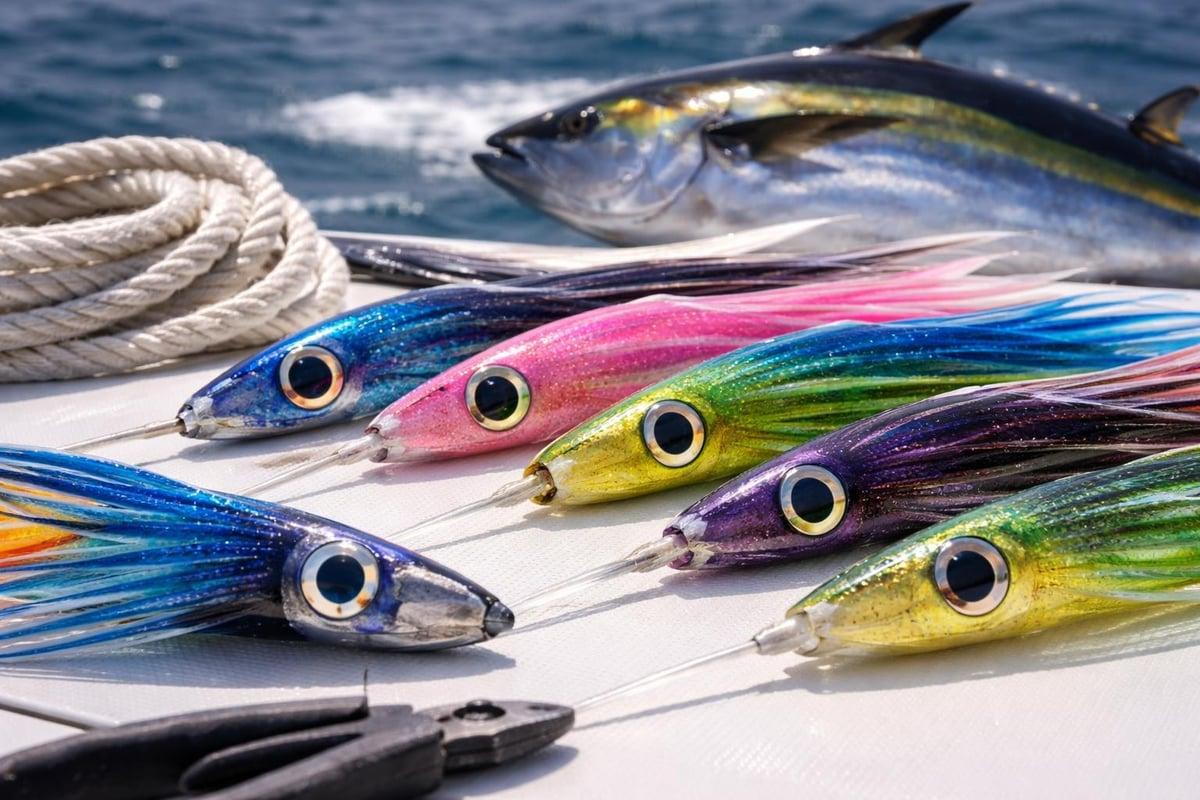
Tuna are fast, sight-feeding predators that key in on baitfish, squid and anything moving quickly through the water. Choosing the right lures, and running them at the right speed and depth, makes the difference between a long ride home and a hookup. This guide covers the main tuna lure types for trolling, jigging and topwater casting, how to match lures to tuna species and conditions, and how to rig and maintain them. For natural baits, see the companion guide on tuna bait.
What Triggers a Tuna Strike
Tuna have excellent eyesight and hunt prey like squid, mackerel and flying fish. Strikes are triggered by:
- Speed and flash that mimic fleeing prey
- Vibration like that of an injured baitfish
- Color contrast that's visible at depth
- Size that matches the local forage
Water clarity, sea state and time of year all change what works; what produces off the Outer Banks might not produce off San Diego. Most successful anglers carry a variety of styles. See Salt Water Sportsman's roundup of tuna fishing lures (opens in a new tab).
Trolling Lures
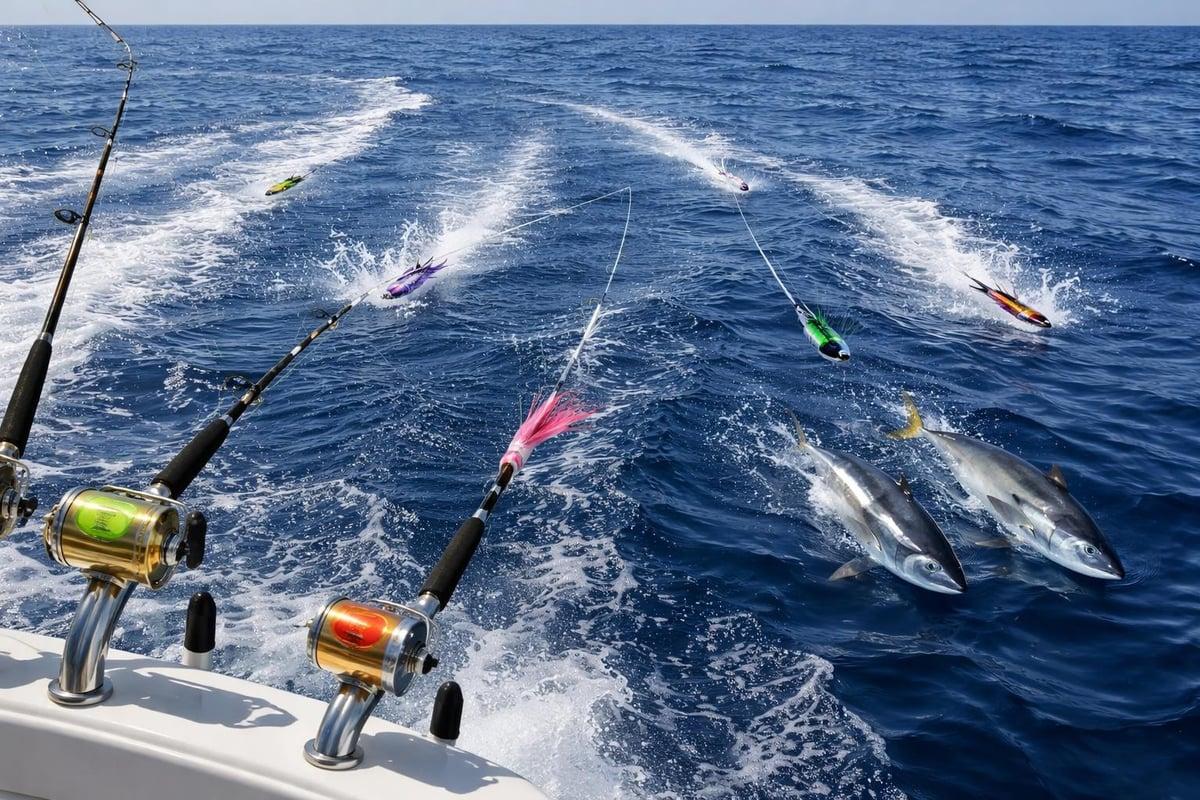
Trolling is the go-to method for covering water and finding active schools. Most anglers troll at 6 to 9 knots, with some lures run up to 10 knots. Vary your speed through the day: start around 7 knots, adjust based on strikes, and when you hook up, note the speed and repeat it.
Skirted Lures and Jet Heads
Skirted lures are the backbone of most tuna spreads. A weighted head with flowing skirts imitates squid and baitfish and leaves a bubble or "smoke" trail that draws tuna from a distance. Bullet-style and jet heads cut through the water with aggressive bubble trails, and head shape changes the swimming action and dive depth. Green machines and similar patterns produce across many tuna fisheries. Mix straight-running and diving lures at different distances so the spread looks like a natural school.
Cedar Plugs and Feathers
Cedar plugs are torpedo-shaped wooden or resin lures with a tight wobble at high speed, and they've caught tuna for generations. They shine when tuna feed on smaller baitfish, work well for smaller tuna species, and are simple and reliable for beginners. They're also cheap enough that losing one to a wahoo won't hurt. Run them on the short riggers, flat lines or as part of a dredge setup. Feather jigs have an erratic action; mix feather colors for water clarity and replace worn feathers.
Hard-Bodied Diving Lures
Diving lures dive and wobble, adding another depth to the spread. Rigged ballyhoo can also be combined with lures for a natural presentation.
Spreader Bars and Daisy Chains
Spreader bars (opens in a new tab) hold multiple squid or fish imitations on rigid bars that keep their spacing on the troll, creating the look of a school and triggering competitive feeding. Daisy chains give a similar effect with a more flexible setup. They're especially effective for yellowfin feeding on squid, and for larger bluefin and bigeye. Some anglers run a single spreader bar on a long rigger line; others run several at different positions. Match squid colors to local forage, and check the rigging before each trip.
Green-Sticking
Green-sticking (opens in a new tab) uses a tall fiberglass pole, about 15 to 20 feet, to skip daisy chains of synthetic squid across the surface above the boat's wake. It has been especially effective for bluefin. It requires maintaining the right boat speed to keep the lures dancing, and clearing lines quickly after a strike.
Setting the Spread
A typical spread runs long riggers 75 to 150 feet back, flat lines at 50 to 100 feet, and a shotgun at 200 feet or more to create a natural-looking school.
Vertical Jigging
Jigging targets tuna holding deep: around ledges, seamounts, wrecks and other structure, below the thermocline, or when you mark fish that ignore trolled lures. It needs less boat movement and lets you work the exact depth where fish are holding. Injured baitfish flutter as they fall, and a well-worked jig imitates that; many bites come on the fall.
Jig Weight
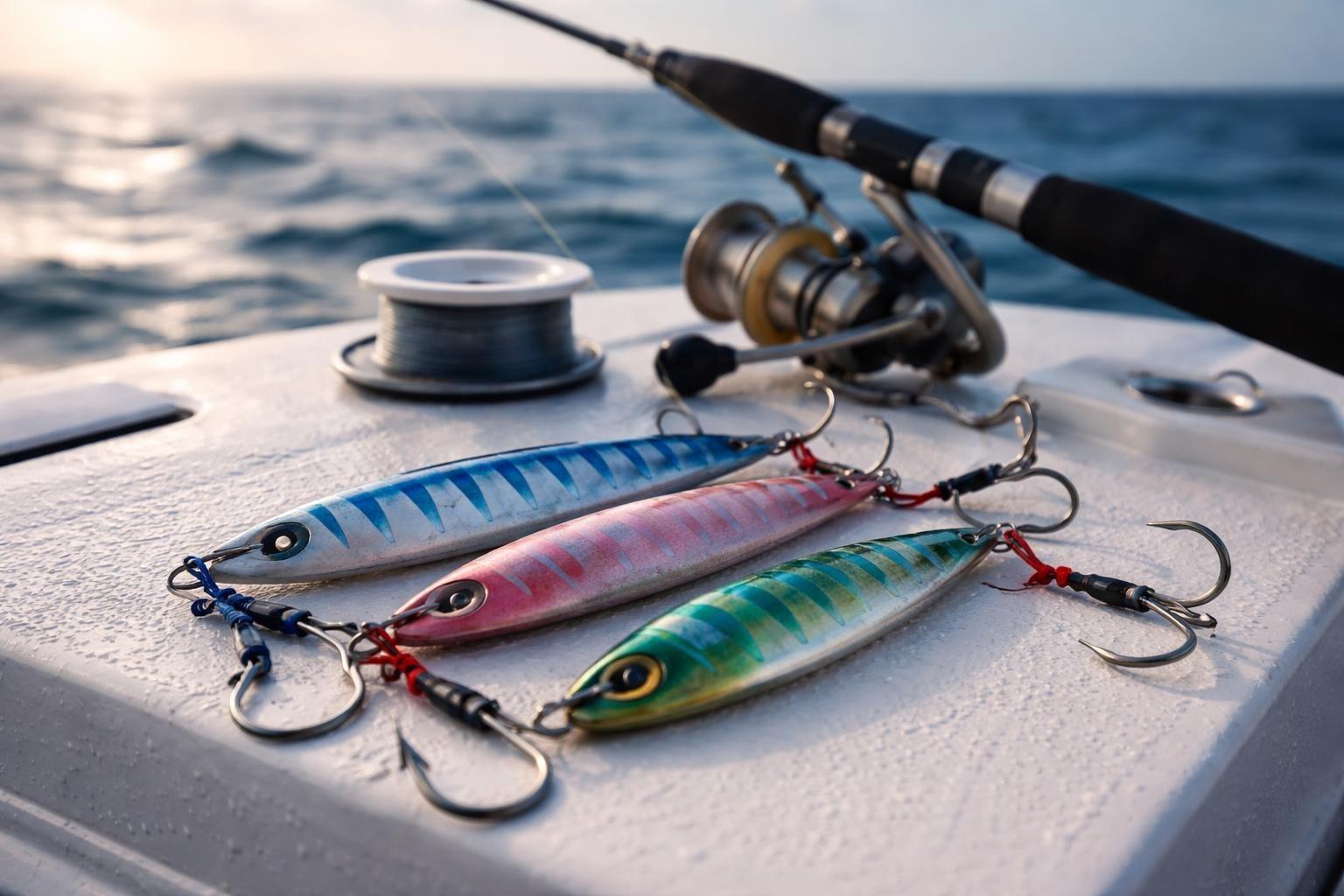
Weight is the most important choice. Too light and you'll struggle to reach the fish in current; too heavy and you may drop past active fish or lose the action. Most tuna jigs fall between about 80 and 400 grams: roughly 100 to 200 grams for 50 to 150 feet, and 250 to 400 grams for 200 feet or more or strong current. Current changes everything, so carry a range of weights. See these offshore tuna jig selections (opens in a new tab).
Jig Styles
- Knife jigs: long and thin, dropping fast and straight. Suited to deep water, strong current and tuna keyed on small baitfish.
- Butterfly jigs: wider and flatter with an erratic flutter. Deadly for aggressive fish but harder to fish in current.
- Speed jigs: for fast, aggressive retrieves and fish chasing fast-moving bait.
- Slow-pitch jigs: for finicky biters.
- Flat-fall jigs: "helicopter" down naturally.
Match the jig profile to the main baitfish.
Working a Jig
Drop on a semi-tight line so you feel the jig reach bottom or your target depth. If you're marking fish at 120 feet, drop just below the marks and work up through them rather than starting at 200 feet.
- High-speed retrieve: crank fast while pumping the rod tip for a fleeing-baitfish action. Tiring but effective when tuna are hot.
- Slow pitch: lift the rod tip three or four feet, drop it back while reeling up slack, then pause. The jig flutters on the drop and often gets hit during the pause.
- Yo-yo: drop, crank up several turns quickly, and drop again to find the depth where fish are holding.
Jigging Tackle
Use a conventional reel with 40- to 65-pound braid and a high gear ratio (around 6:1 or higher) to catch up to falling jigs, plus a solid drag. Shorter rods of 5.5 to 6.5 feet give better leverage for vertical jigging. Most jigs come with assist hooks on Kevlar or heavy braid at the top of the jig. They hang just beyond the nose, hook fish that strike on the fall, and tend to find the corner of the mouth. Many anglers upgrade factory split rings to heavy-duty ones before fishing. Leaders typically run 60- to 100-pound fluorocarbon for jigging, heavier for big fish or around structure. Carry spare jigs already rigged.
Topwater: Poppers and Stickbaits
When tuna are busting bait on the surface, especially at dawn and dusk, around floating debris and weed lines, or wherever birds are working, topwater produces explosive strikes.
- Poppers have cupped faces that throw water and make noise. Sizes of 5 to 9 inches suit most tuna. Work them with sharp, aggressive pops and pauses.
- Stickbaits and pencil poppers have a side-to-side walk-the-dog action, created with long sweeps of the rod, that imitates wounded fish. It often outfishes aggressive popping when tuna are pressured, selective or following without committing.
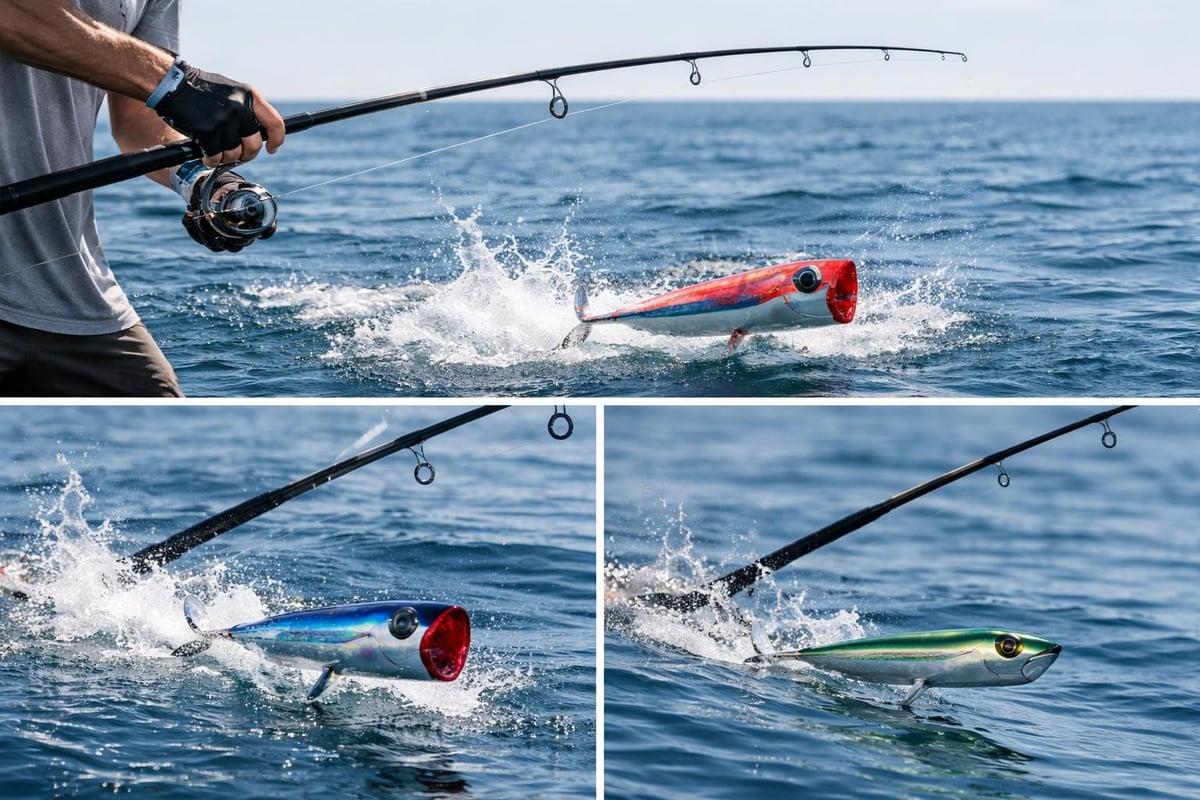
Match lure size to visible baitfish, cast beyond the boil and retrieve through it, keep the rod tip low for better hooksets, use heavy braid for long casts, and vary your cadence until you trigger strikes. Calm to moderate seas are better than heavy chop for topwater. Many anglers prefer inline single hooks or assist hooks on poppers and stickbaits for better landing rates on jumping fish.
Some anglers experiment offshore with freshwater bass poppers such as the MONSTERBASS Mad Max. If you do, upgrade everything: saltwater-grade hooks in place of stock trebles, 50- to 80-pound braid, a leader, heavy-duty split rings, and an offshore-capable rod and reel. Stock hardware typically fails under sustained offshore pressure, and dedicated offshore poppers are more reliable.
Matching Lures to Tuna Species
- Skipjack, albacore and blackfin hit almost anything moving through their feeding zone, including smaller feather jigs and cedar plugs. Blackfin respond well to small skirted lures, feathers and metal jigs of 3 to 5 inches, and they concentrate around structure.
- Yellowfin aggressively hit spreader bars and squid chains. Lures of about 6 to 12 inches match their usual forage, and 6- to 9-inch skirted lures suit most situations. Nearshore lumps and temperature breaks can concentrate yellowfin that readily hit smaller high-speed lures.
- Bluefin are more selective, and larger fish can be notoriously finicky. Offshore canyons and deep structure often hold larger bluefin.
Size preferences vary with the bait tuna are feeding on. Yellowfin often respond to faster presentations, while bluefin keyed on small bait can be fooled by smaller 4- to 6-inch lures. When bluefin are on the surface, metal jigs or poppers can produce explosive strikes.
Some regions offer inshore opportunities where skipjack and smaller yellowfin come within range of smaller boats; these favor lighter tackle and smaller lures. Around Key West and Islamorada, local bait patterns often dictate which colors produce.
Color
Color depends mainly on water clarity and light:
- Clear blue water: natural, subtle presentations with realistic flash, such as chrome and silver, blue and white, or bone and pearl. Purple and black add silhouette.
- Green or stained water: brighter, high-contrast patterns such as chartreuse, pink, orange, chartreuse and orange, pink and white, or green and yellow.
- Low light: glow finishes, UV-reflective materials and metallic finishes; pink and purple for low light or deeper water.
- Weed lines and floating debris: green and yellow.
For jigs, silver and chrome imitate most baitfish, blue and silver match sardines and anchovies, and pink and chartreuse have their moments when tuna feed on squid or in stained water. Carry duplicates in different colors and run a mixed spread; when one pattern stops producing, switching colors can restart the bite. Some crews rotate colors every hour or so until they find what's working. Tuna can be color-selective on some days and not on others.
Rigging and Maintenance
- Leaders: fluorocarbon of 80 to 130 pounds for most trolling, heavier for bigger fish and abrasive conditions. Leaders of 10 to 15 feet are common for most trolling applications.
- Hooks: 7/0 to 10/0 matched to lure size for trolling, circle hooks or J-hooks depending on preference. Circle hooks are popular for conservation and solid hookups. Single hooks often work better than trebles for catch-and-release.
- Hardware: tuna test every component. Use heavy-duty swivels rated for big game, crimps or wind-on leaders for clean connections, and properly sized heavy-duty split rings.
Check hook points after every fish and replace bent or damaged hooks. After each trip, rinse all lures with fresh water, paying attention to hooks and split rings, replace torn skirts before they fail, and store lures so they don't tangle.
A starting collection might include six skirted trolling lures in various colors, four cedar plugs or bullet-style lures, two topwater poppers, a selection of metal jigs, and spare skirts and hooks.
Related Fishing Spots
About the Author
Matthew Howe
Matthew Howe is the founder of Find Fishing Spots and a lifelong fishing and boating enthusiast. He created FindFishingSpots.com to help anglers discover fishing locations, tournaments, and useful resources for getting on the water.