
The Secret Slammer for Blackfin Tuna and Yellow Jack: The Mustad Moonriser Jig
How to fish Mustad's slim, front-weighted Moonriser jig for blackfin tuna and yellow jack — plus the Florida Spots and tournaments where they're listed.
Matthew HoweUpdated
Related Species
- Blackfin Tuna
- Yellow Jack
Blackfin tuna and yellow jack don't often share a headline, but they share a problem for the angler: both are fast fish that feed around deep structure, and both are easier to reach with a jig that gets down quickly and stays under control. The Mustad Moonriser (opens in a new tab) is one of those jigs — long, slim and weighted toward the head. It isn't a secret in the sense that nobody knows about it; it's more that it gets overlooked next to flashier slow-pitch patterns. Here is what Mustad actually says about it, how anglers fish this style of jig for each species, and where in our Florida data those fish are listed.
What the Mustad Moonriser Jig Is
Mustad sells it as the Moonriser Jig (item MJIG03). You'll also see it called the "Moon Riser" or a "speed jig" at retailers and on forums, but "speed jig" is the trade's label, not Mustad's. Here is what Mustad's own product page and video state:
- A slim profile with the weight concentrated near the head.
- A streamlined shape that descends quickly with little water resistance, which Mustad says suits spots near structure such as wrecks and lets anglers jig in deeper water.
- Six weights: 90, 120, 150, 200, 250 and 300 grams (Mustad lists these as roughly 3.5 to 11 ounces).
- Nine finishes, including Blue Sardine, Pink Sardine, Green Mackerel, Full Chrome and one called Yellow Fin Tuna.
- Recommended action: long strokes with a moderate retrieve speed.
Mustad's Amazon listing describes it as a front-weighted vertical jigging lure for tuna. Mustad's product page doesn't list the hook model or assist-hook setup, so check what's rigged on the jig you buy and change it if it doesn't suit the fish and tackle you're using.
Speed Jigging, Long Strokes and Where the Moonriser Fits
"Speed jigging" usually means fast, rhythmic work: a short, springy rod, a high-speed reel and short bursts of cranking that load the rod tip and make the jig dart up the water column. Salt Water Sportsman (opens in a new tab) describes that style as a vertical walk-the-dog action driven by the reel rather than the rod, typically on heavy braid (40-pound as a minimum, often heavier) with the assist hooks attached to a welded ring.
Slow-pitch jigging sits at the other end: shorter, leaf-shaped jigs that flutter and glide on the fall. The Moonriser is closer to the first family in shape — a long, front-weighted jig that drops fast and tracks straight — but Mustad's own advice is long strokes at a moderate pace, not a frantic retrieve. In practice that makes it a flexible tool: you can burn it through a school of tuna, or work it with long lifts over a wreck. There is no single correct cadence, and the fish usually tell you which one they want on a given day.
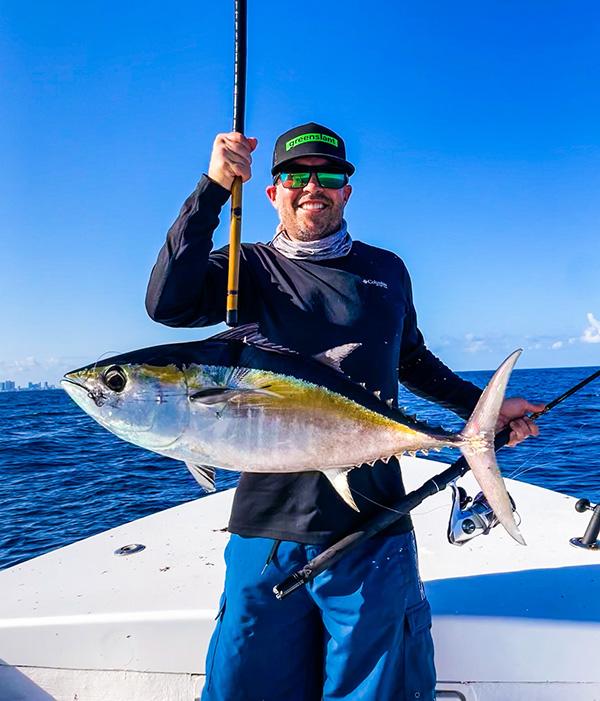
Fishing the Moonriser for Blackfin Tuna
Blackfin tuna are a coastal-to-offshore species (FWC (opens in a new tab)) that gather around deep structure where bait holds. A Florida Sportsman report on Keys blackfin jigging (opens in a new tab) describes the common pattern around the seamounts off the Keys: start the drift upcurrent of the hump's peak so the jig has time to reach the strike zone as the boat slides over the structure. That report says most bites come on the descending flutter or on the retrieve, and a take on the drop often shows up as the jig suddenly stopping — so stay in touch with the line on the way down.
With a long jig like the Moonriser, that translates into a few practical habits:
- Watch your electronics. Marks suspended well off the bottom are worth jigging through; you don't always need to go all the way down.
- Don't free-spool blindly. Thumb the spool lightly on the drop so you feel the jig stop.
- Vary the retrieve. Start with long strokes at a moderate speed (Mustad's recommendation), then try faster, shorter bursts if the fish are chasing but not eating.
- Mind the drift. If the line angle blows out, the jig is no longer where you think it is — go heavier or reposition.
Tackle for blackfin ranges more than many anglers expect. The Florida Sportsman piece describes light-tackle crews using 15- to 20-pound-class gear with 25- to 30-pound fluorocarbon leaders, while dedicated speed-jigging setups run much heavier braid. Neither is wrong; it depends on the size of the fish, how much you care about the fight, and whether sharks are taking hooked fish where you're fishing.
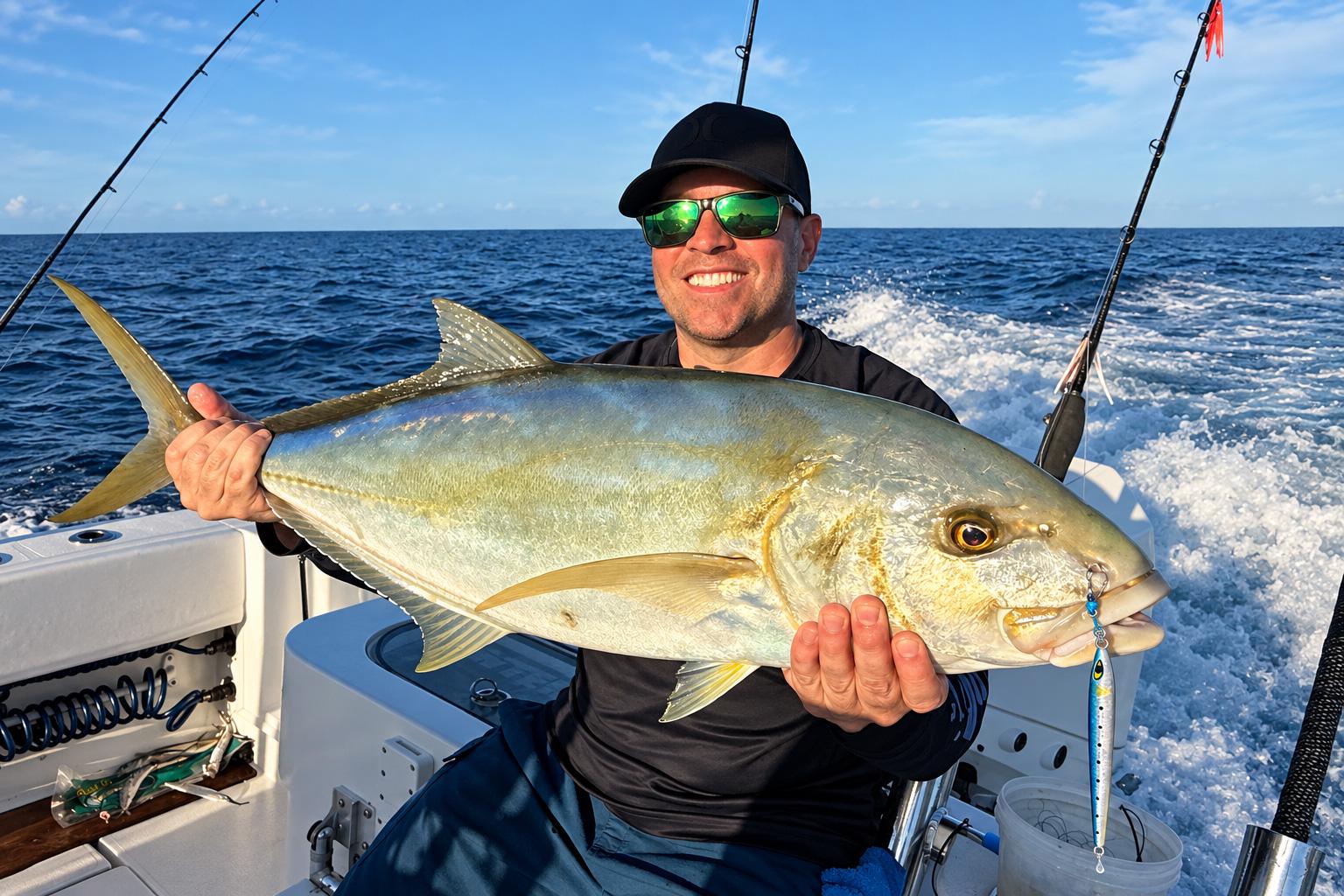
Fishing It for Yellow Jack
Yellow jack are a reef and wreck fish. Florida Sport Fishing (opens in a new tab) describes them from shallow reef tops down to roughly 180 feet on offshore drop-offs, around ledges, wrecks, coral and sand edges near the reef. The Florida Museum (opens in a new tab) notes they are usually solitary or in small groups, feeding on small reef fish.
That changes how you fish the jig compared with tuna:
- Fish closer to the structure. Where tuna may be anywhere in the water column, yellow jack are usually tied to the reef or wreck itself.
- Go lighter. Florida Sport Fishing suggests medium spinning or conventional tackle with 20- to 30-pound braid and a fluorocarbon leader, which lets a lighter Moonriser work properly in modest depths.
- Expect a hard, sudden strike. Jigs worked with a fluttering, injured-bait motion around deeper wrecks are one of the methods that article describes.
If you plan to keep one, note that the Florida Museum lists yellow jack as a high-risk species for ciguatera. Check current advice before eating reef fish from any given area.
Choosing a Moonriser Weight
There is no universal chart for jig weight, and Mustad doesn't publish one for the Moonriser. The principle anglers use is simple: pick the lightest jig that still reaches the fish and stays close to vertical in the current and drift you have. For reference, the Florida Sportsman blackfin report used jigs of about 3.5 to 7 ounces on the Keys humps, which lines up with the middle of the Moonriser range (roughly 120 to 200 grams). Shallower reefs for yellow jack generally call for the lighter end; strong current, deep water or a fast drift push you heavier. Bring more than one weight.
Watch: Mustad's Moonriser Vertical Jig
Mustad's own short video shows the Moonriser's shape and how it's meant to move. It's a product overview rather than a fishing trip, but it's the clearest look at the jig itself.
Florida Fishing Spots Where Blackfin Tuna Is Listed
Blackfin Tuna is listed on 12 Florida Spots in Find Fishing Spots — all but one offshore. A listing means the species is associated with that Spot in our data; it isn't a catch report or a guarantee. Depths below are the depths recorded for each Spot.
- Miami Humps — deep-water humps east of Miami (recorded at 395–515 feet).
- Key Largo Hump South — an offshore seamount off Key Largo (400–700 feet).
- The 409 Hump South — an offshore hump listed under Marathon (400–1,000 feet).
- OL Bodenhamer Steel Liberty Ship — a 450-foot Liberty Ship off Miami-Dade (365 feet).
- Catharina Tugboat and Shark Cargo Tug Wreck — two deep tug wrecks off Miami Beach and Sunny Isles (284 and 255 feet).
- Rossmerry Steel Freighter — a 195-foot freighter off Bal Harbour (240 feet).
- USS S-16 Submarine Wreck — a historic submarine wreck off Key West (231 feet).
- Hugo's April Fool Steel Shipwreck — a shallower offshore wreck off Miami-Dade (145 feet).
One shore option is on the list too: the Bal Harbour Fishing Jetty, whose description mentions the occasional blackfin at the inlet. To see everything around a port, browse Miami, Key Largo, Marathon and Key West and filter by Species.
Yellow Jack in Our Florida Data
Yellow Jack is a newer Species in Find Fishing Spots, and so far it is listed on one Florida Spot: the USS S-16 Submarine Wreck off Key West, which also lists Blackfin Tuna. That's a thin list rather than a statement about where yellow jack live — they're found on South Florida reefs and wrecks, and more Spots will pick up the Species as our data grows.
Florida Tournaments With a Blackfin or Tuna Category
These events publish a tuna category on their official sites. Check each event page for current dates and rules, as details change year to year.
- Marathon Fire Rescue Wahoo Fishing Tournament — Marathon; lists a blackfin tuna division alongside wahoo and kingfish.
- El Pescado Billfish Tournament — St. Augustine; its gamefish division includes tuna.
- Marathon Offshore Bull & Cow Dolphin Tournament — Marathon; a dolphin tournament that also awards a blackfin tuna category.
Regulations
Rules change, so check them before every trip rather than relying on an article. The FWC's billfish and tuna page (opens in a new tab) sets out the blackfin tuna rules for recreational anglers, including where they apply in state and federal waters. For yellow jack and other reef species, start with FWC's saltwater regulations (opens in a new tab); in federal waters, NOAA Fisheries' Southeast recreational pages (opens in a new tab) explain which rules apply.
Before You Go
- Bring the Moonriser in at least two weights so you can stay vertical as the current and drift change.
- On a tuna drift, pay attention on the fall — a jig that stops sinking early may be in a fish's mouth.
- For yellow jack, work the jig near the reef or wreck, not high in the water column.
- Use a leader you're comfortable with for the water clarity and the chance of sharks, and check hooks and rings after every fish.
- Check FWC and NOAA rules on the day, and watch the weather — most of these Spots are well offshore.
Explore More
Browse all Florida fishing Spots and use a city's Species filter to find Blackfin Tuna and Yellow Jack Spots near your port. For other ways to target tuna, see Tuna Lures: Trolling, Jigging and Topwater and Tuna Bait: Live Bait, Chunking and Chumming.
Related Locations
Related Fishing Tournaments
Marathon Fire Rescue Wahoo Fishing Tournament 2026
Oct 23–Oct 24, 2026 · Marathon, Florida
El Pescado Billfish Tournament 2026
Nov 3–Nov 7, 2026 · St. Augustine, Florida
21st Annual Tom Thumb Marathon Offshore Bull & Cow Dolphin Tournament
Apr 30–May 2, 2027 · Marathon, Florida
About the Author
Matthew Howe
Matthew Howe is the founder of Find Fishing Spots and a lifelong fishing and boating enthusiast. He created FindFishingSpots.com to help anglers discover fishing locations, tournaments, and useful resources for getting on the water.